
The Dead Man (Der tote Mann)
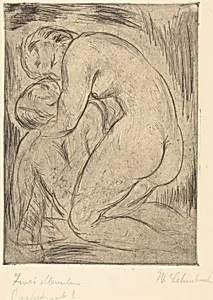
Medium
drypoint [trial proof]
Classification
Department
CG-W
Museum
National Gallery of Art, Washington, D.C.
Credit
Rosenwald Collection
Accession Number
1952.8.257
Rights
Public Domain
Art Historical Context
**The Dead Man (Der tote Mann)**, created by German Expressionist Wilhelm Lehm in 1915, captures the profound anguish of World War I a stark, elongated figure. Lehmbruck, renowned for his sculptures of slender, spiritually charged forms, translated his style into this haunting drypoint print amid the war's early devastation. As a trial proof from the National Gallery of Art's Rosen Collection, it offers a rare glimpse into the artist's experimental process, printed before final refinements. Drypoint technique involves scratching directly into a metal plate with a needle, raising a burr that yields rich, velvety lines and subtle textures—ideal for conveying emotional depth. Lehmbruck's loose, intuitive marks evoke vulnerability and isolation, aligning with Expressionism's rejection of realism in favor of inner turmoil. This intimate medium allowed the artist to explore mortality's weight during a conflict that claimed millions. Held in the Print department (CG-W), this work exemplifies Lehmbruck's brief but impactful printmaking phase before his tragic death in 1919. For visitors, it stands as a poignant reminder of art's power to confront human suffering, bridging sculpture's monumentality with print's accessibility.
About the Artist
Wilhelm Lehmbruck · 1881–1919
Wilhelm Lehmbruck (1881–1919) was a German sculptor whose elongated, melancholic figures rank among the most moving works produced by European Expressionism. Born in Duisburg-Meiderich into a working-class family, Lehmbruck studied at the School of Arts and Crafts in Düsseldorf and later at the Düsseldorf Academy, where he mastered the academic tradition before pushing beyond it toward a more pers...