
The Death of Lazarus
1620–76
Medium
Etching with engraving
Dimensions
Sheet (trimmed): 10 1/16 × 12 11/16 in. (25.6 × 32.2 cm)
Classification
Prints
Department
Drawings and Prints
Museum
Metropolitan Museum of Art, New York, NY
Credit
The Elisha Whittelsey Collection, The Elisha Whittelsey Fund, 1951
Accession Number
51.501.2270
Rights
Public Domain
Tags
Art Historical Context
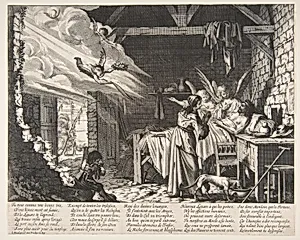
*The Death of Lazarus* is a striking 17th-century print created through the collaborative efforts of French artists Abraham Bosse and Jean Leblond, spanning their active years from 1620 to 1676. Bosse, a master reproductive printmaker influenced by the Baroque style, specialized in etching intricate scenes from paintings, while Leblond contributed engraving skills for precise detailing. This work, housed in the Metropolitan Museum of Art Drawings and Prints department, captures a poignant biblical moment from the Gospel of John, depicting the death of Lazarus—the brother of Mary and Martha, famously raised by Jesus—surrounded by mourning figures including angels, women, dogs, and saints. The medium of etching combined with engraving was revolutionary in the era, allowing artists to translate paintings into affordable, widely distributable prints. Etching's fluid lines conveyed emotional drama, while engraving added sharp clarity to textures like flowing robes and expressive faces, making complex compositions accessible to a broader audience beyond elite collectors. Produced during France's Golden Age under Louis XIII and XIV, such prints reflected the Counter-Reformation's emphasis on dramatic religious narratives to inspire faith. This piece invites visitors to ponder themes of mortality and divine intervention, with its lively tags—angels hovering in sorrow, faithful dogs at bedside, and saintly witnesses—evoking the intimate humanity of sacred stories. A testament to printmaking's golden age, it remains a gem in The Elisha Whittelsey Collection.
About the Artist
Abraham Bosse|Jean I Leblond · 1602–1676
Abraham Bosse (1604–1676) was a French printmaker and theorist whose approximately 1,600 etchings provide an unparalleled visual record of 17th-century French life. Born to Huguenot parents in Tours, he trained in Paris under Melchior Tavernier and became a devoted follower of Jacques Callot's technical innovations. Bosse's meticulous etchings depicted subjects ranging from daily life and fashion ...