
The Death of Sadi Carnot
1894
Medium
Bronze, struck
Dimensions
3 1/8 × 2 3/16 in. (79 × 56 cm)
Classification
Medals and Plaquettes
Culture
French
Department
European Sculpture and Decorative Arts
Museum
Metropolitan Museum of Art, New York, NY
Credit
Gift of David and Constance Yates, in memory of Victoria Blumka Nasatir Goldberg, 1992
Accession Number
1992.106a, b
Rights
Public Domain
Tags
Art Historical Context
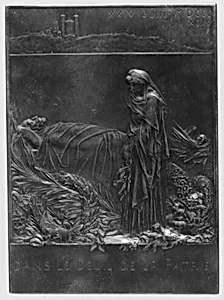
In the European Sculpture and Decorative Arts collection at the Metropolitan Museum of Art, Louisscar Roty's *The Death of Sadiot* (1894) is a poignant bronze medal measuring just 3 1/ × 2 316 inches. Struck in bronze—a technique involving high-pressure dies to create finely detailed reliefs—this plaquette exemplifies the French medallic art tradition of the fin-de-siècle. Roty, a master engraver and leading figure in the Art Nouveau movement, was renowned for his intricate, flowing designs that blended classical precision with modern elegance, often commemorating pivotal historical moments. The medal honors Marie François Sadi Carnot, President of France's Third Republic from 1887 until his tragic assassination on June 24, 1894, in Lyon by an Italian anarchist. Produced mere months after the event, it captures the national mourning for Carnot, a symbol of republican stability amid rising political tensions and anarchist threats in Europe. Tags noting men, women, and death suggest a dramatic scene, possibly including Carnot's final moments or grieving figures, underscoring the era's fascination with mortality in public life. These small-scale masterpieces like Roty's were prized as affordable yet sophisticated memorials, circulated among collectors and the bourgeoisie. Gifted to the Met in 1992 in memory of Victoria Blumka Nasatir Goldberg, this piece invites visitors to reflect on how art immortalizes fleeting history.
About the Artist
Louis-Oscar Roty · 1846–1911
Louis-Oscar Roty, commonly known as Oscar Roty (1846–1911), was born on June 11 in Paris's Belleville neighborhood, the son of a modest schoolmaster. He began his artistic training under Horace Lecoq de Boisbaudran at the Petite École (later the École des Arts Décoratifs), honing his drawing skills, before entering the École des Beaux-Arts in 1864. There, he studied sculpture and medal engraving u...