
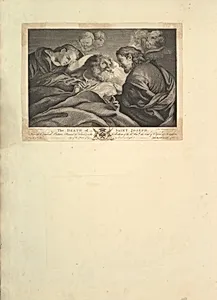
The Death of St. Joseph
Medium
Engraving
Dimensions
sheet: 11 x 14 15/16 in. (28 x 38 cm)
Classification
Prints
Department
Drawings and Prints
Museum
Metropolitan Museum of Art, New York, NY
Credit
Harris Brisbane Dick Fund, 1925
Accession Number
25.62.49v
Rights
Public Domain
Tags
Art Historical Context
Behold *The Death of St.*, a poignant 1766 engraving held in the Metropolitan Museum of's Drawings and Prints department This print reproduces a composition attributed to the masterful Spanish Baroque artist Diego Rodríguez de Silva y Velázquez, for his dramatic religious scenes and lifelike figures during Spain's Golden Age. The scene captures the serene yet profound moment of Saint Joseph's passing, surrounded by Christ, angels, and symbolic elements like coats of arms, evoking Catholic devotion and the sanctity of family in Christian iconography. Crafted as an engraving on a modest sheet measuring 11 x 14 15/16 inches, the work involves contributions from Alexander Bannerman, Alonso Cano, and publisher John Boydell, a key figure in 18th-century London's thriving print trade. Engravings like this were revolutionary for their time, enabling the mass reproduction and dissemination of prestigious paintings to a broader audience beyond elite collectors. Acquired through the Harris Brisbane Dick Fund in 1925, it exemplifies how prints bridged art worlds, preserving Velázquez's influence long after his death. This artwork invites reflection on mortality and divine comfort, blending Velázquez's tenebrism—those masterful light-and-shadow effects—with the precise lines of engraving, making sacred narratives accessible and enduring.
About the Artist
Velázquez (Diego Rodríguez de Silva y Velázquez)|Alexander Bannerman|Alonso Cano|John Boydell · 1599–1660
Diego Rodríguez de Silva y Velázquez, baptized on June 6, 1599, in Seville, Spain, emerged as one of the supreme masters of the Spanish Baroque. The eldest son of notary Juan Rodríguez de Silva and Jerónima Velázquez, he displayed prodigious talent early on. At around age 11 or 12, he apprenticed under Francisco Pacheco, the esteemed Sevillian painter, theorist, and writer whose studio functioned ...