
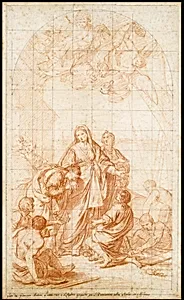
The Departure of Saint Paula and Saint Eustochium for the Holy Land
1740
Medium
Red chalk; squared in black chalk
Dimensions
15 7/8 x 9 5/8in. (40.3 x 24.4cm)
Classification
Drawings
Department
Drawings and Prints
Museum
Metropolitan Museum of Art, New York, NY
Credit
Gift of John Morton Morris, 1987
Accession Number
1987.245
Rights
Public Domain
Tags
Art Historical Context
This evocative drawing by Giuseppe Bottani portrays the fourth-century departure of Saint Paula and her daughter Saint Eustochium for the Holy Land, a pivotal moment in early Christian history when the noble Roman women left behind their privileged lives to follow Saint Jerome on a pilgrimage of faith. in 1740, scene captures themes of, sacrifice, and spiritual that resonated strongly in 18th-century religious art. Bottani rendered the composition in red chalk, a medium favored for its warm, velvety tones and capacity to suggest both delicate flesh and flowing drapery. The sheet is squared in black chalk, a practical technique that allowed the artist to scale the design accurately for transfer to a larger painting or fresco. Through careful grouping of male and female figures, the drawing conveys both movement and quiet resolve. As a preparatory study, the work offers insight into Bottani’s thoughtful process and the continued appeal of hagiographic subjects in Italian art of the period. Today it invites viewers to appreciate the human stories behind these timeless saints.
About the Artist
Giuseppe Bottani · 1717–1784
**Giuseppe Bottani** (1717–1784) was an Italian painter active during the late Baroque period, with works that bridged classical traditions and emerging Neoclassical tendencies. Born in Cremona, he spent his boyhood in Pontremoli before being sent to Florence for artistic training. There he studied under Vincenzo Meucci and Antonio Puglieschi. He later moved to Rome, where he worked under Agostino...