
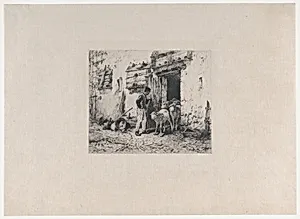
The Departure of the Flock
Medium
Etching and drypoint
Dimensions
Sheet: 11 5/8 × 16 1/16 in. (29.5 × 40.8 cm) Plate: 5 11/16 × 6 3/4 in. (14.5 × 17.2 cm)
Classification
Prints
Department
Drawings and Prints
Museum
Metropolitan Museum of Art, New York, NY
Credit
Gift of Mrs. Hermann Warner Williams Jr., 1958
Accession Number
58.559.164
Rights
Public Domain
Tags
Art Historical Context
*The Departure of the Flock (1880) is a delicate etching and drypoint by Félix Brissot deville, with printing likely overseen by the esteemed publisher Alfred Cadart. Brissot, a French artist renowned for his animalier scenes, captures a poignant pastoral moment: shepherds guiding a flock of sheep away from rustic houses under an open sky. The tags—animals, houses, men—ev the timeless rhythms of rural life in 19th-century France, human activity with the natural world in a style reminiscent of the Barbizon school's earthy realism. Etching involves incising lines into a metal plate with acid, while drypoint adds direct scratches that create a velvety burr for soft, textured effects—ideal for rendering woolly sheep and atmospheric depth. Cadart, a key figure in the 1860s-70s etching revival, championed such intimate prints, making fine art accessible beyond paintings. This small plate (5 11/16 × 6 3/4 in.) on a larger sheet exemplifies the medium's precision and expressiveness. Now in the Metropolitan Museum of Art's Drawings and Prints department, gifted in 1958, the work highlights printmaking's role in democratizing art. Visitors will appreciate its subtle tones and narrative warmth, a window into vanished agrarian harmony.
About the Artist
Alfred Cadart|Félix Brissot de Warville (French| ) · 1816 |1828 –1876 |1875
French, Montmorency 1816–1876|