
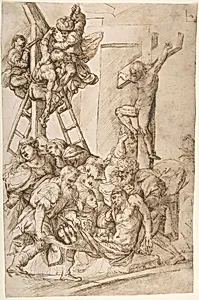
The Deposition from the Cross
1537–1550
Medium
Pen and brown ink
Dimensions
14 3/4 x 9 5/16 in. (37.4 x 23.7 cm)
Classification
Drawings
Department
Drawings and Prints
Museum
Metropolitan Museum of Art, New York, NY
Credit
Purchase, David T. Schiff Gift and Harry G. Sperling Fund, 2001
Accession Number
2001.89
Rights
Public Domain
Tags
Art Historical Context
Domenico Campagnola's *The Deposition from the Cross (1537–1550) a pivotal moment from the Passion of Christ: the solemn removal of Jesus's body from the cross following the Crucifixion. Rendered in pen and brown ink, this measures 14 3/4 x 9 5/16 inches and exemplifies the Venetian Renaissance tradition. Campagnola, a draughtsman and print influenced by masters like Titian, employs fluid, expressive lines to convey the figures' grief and physical effort—men ascending ladders to lower the lifeless Christ, evoking deep religious emotion central to 16th-century Italian art. The medium of pen and brown ink was prized in the Renaissance for its precision and tonal depth, allowing artists like Campagnola to model forms through hatching and cross-hatching without color. This technique highlights the dramatic interplay of bodies and the stark symbolism of the cross, making the work both a devotional study and a virtuoso display of draftsmanship. Likely created as an independent sheet or preparatory drawing, it reflects the era's fascination with biblical narratives amid the Catholic Reformation's emphasis on sacred imagery. Acquired by The Metropolitan Museum of Art in 2001 through generous gifts, this piece invites visitors to ponder the human scale of divine tragedy, bridging artistry and faith in a compact, intimate format.
About the Artist
Domenico Campagnola · 1500–1564
Domenico Campagnola (c. 1500–1564), a Venetian Renaissance painter, engraver, and pioneering draftsman, was born around 1500, likely in Venice to German parents, and became a child prodigy under the tutelage of his adoptive father, Giulio Campagnola. Apprenticed to Giulio around 1507 in Venice, he mastered painting, drawing, engraving, and woodcutting from the esteemed Paduan engraver, whose stipp...