
The Descent from the Cross
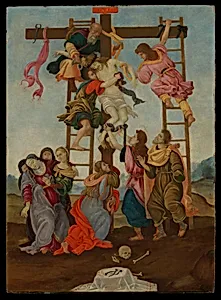
Medium
Tempera on wood
Dimensions
22 x 16 in. (55.9 x 40.6 cm)
Classification
Paintings
Department
European Paintings
Museum
Metropolitan Museum of Art, New York, NY
Credit
John Stewart Kennedy Fund, 1912
Accession Number
12.168
Rights
Public Domain
Tags
About this artwork
The Descent from the Cross by Filippino Lippi, 1477–1504. Created in Tempera on wood, this work exemplifies the artistic practices and cultural values of its period. The piece reflects the technical skills and aesthetic sensibilities characteristic of its historical and cultural context. As part of the European Paintings collection, it contributes to our understanding of artistic development and cultural expression. The work serves as both an aesthetic object and a historical document, providing...
Art Historical Context
Filippino Lippi's *The Descent from the Cross captures a poignant moment from the Passion of Christ, depicting the careful lowering of Jesus's body from the crucifix amid grieving figures like the Virgin Mary, Mary Magdalene and Saint John the Evangel. Painted in tempera on wood—a meticulous egg-based medium on panel that was the gold standard for Renaissance altarpieces—this small-scale work (22 x 16 inches) likely served devotional purposes in a Florentine chapel or private collection during the late 15th century, when Lippi flourished (ca. 1477–1504). As the son of Fra Filippo Lippi and a pupil of Botticelli, Filippino blended graceful Florentine Renaissance elegance with expressive emotion. Notice the ladders leaning against the cross, a practical yet symbolic motif emphasizing human tenderness in divine sorrow, and the skulls at the base evoking Golgotha, the site of crucifixion. Tempera's luminous detail allowed Lippi to render intricate drapery and tender gestures, reflecting the era's focus on humanism and religious piety. Acquired by The Metropolitan Museum of Art in 1912 through the John Stewart Kennedy Fund, this panel offers a window into Quattrocento Italy's artistic devotion, where faith and artistry intertwined to inspire contemplation. A gem of European Paintings, it invites visitors to ponder mortality and redemption.
About the Artist
Filippino Lippi · 1457–1504
Filippino Lippi was born around 1457 in Prato, the illegitimate son of the celebrated Florentine painter Fra Filippo Lippi and the nun Lucrezia Buti, who later received a papal dispensation to marry. The family moved to Spoleto, where young Filippino assisted in his father's workshop on the fresco cycle *Life of the Virgin* in the cathedral. Following Fra Filippo's death in 1469, when Filippino wa...