
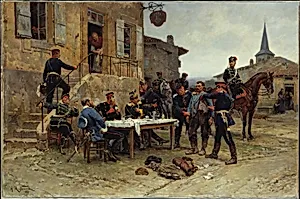
The Dispatch-Bearer
Medium
Oil on canvas
Dimensions
51 1/4 x 84 in. (130.2 x 213.4 cm)
Classification
Paintings
Department
European Paintings
Museum
Metropolitan Museum of Art, New York, NY
Credit
Bequest of Collis P. Huntington, 1900
Accession Number
25.110.26
Rights
Public Domain
Tags
Art Historical Context
Alphonse-Marie-Adolphe de Neuville's *The Dispatch-Bearer* (0), a grand oil on canvas measuring over 7 feet wide, captures a pivotal moment of military urgency amid camaraderie. Painted in a realistic style, it depicts soldiers on horseback, with men pausing for a smoke or drink—evident in the tags of horses, soldiers, smoking, and drinking—highlighting the human side of warfare. De Neuville, a of 19th-century French military art, used the medium's rich textures to render dynamic compositions, dramatic lighting, and intricate details like gleaming uniforms and tense expressions. This work reflects the aftermath of the Franco-Prussian War (1870–71), a conflict that reshaped Europe and inspired de Neuville's oeuvre of battle scenes. As a veteran observer, he brought authenticity to his paintings, blending heroism with gritty realism to commemorate French resilience. Housed in the Metropolitan Museum of Art's European Paintings department through the bequest of Collis P. Huntington in 1900, it invites viewers to ponder the dispatch-bearer's high-stakes role in relaying critical orders. Its large scale immerses visitors in the chaos and pause of war, making it a cultural touchstone for understanding how art immortalizes history's foot soldiers.
About the Artist
Alphonse-Marie-Adolphe de Neuville · 1835–1885
**Alphonse-Marie-Adolphe de Neuville (1835–1885)** was a French academic painter renowned for his vivid, patriotic depictions of military life and battle scenes. Born on 31 May 1835 in Saint-Omer to wealthy parents, he initially pursued a naval career, earning a *bachelier ès-lettres* degree before entering the naval school at Lorient in 1856 against his family’s wishes. There, his artistic talent...