
The Double Screen: Emperor Li Jing Watching his Brothers Play Weiqi 重屏圖
Classification
Painting
Department
Smithsonian Collection
Museum
Smithsonian American Art Museum
Credit
Gift of Charles Lang Freer
Accession Number
F1911.195
Rights
Public Domain
Tags
About this artwork
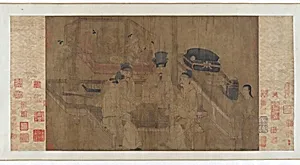
Li Jing, identified by his tall hat, watches two of his brothers play weiqi, while a third looks on. The board, raised on low feet, has a grid of nineteen-by-nineteen lines, the format introduced during the Tang period (618-907). Apparently the game has not progressed very far, since few pieces are visible on the board. The player on the left is about to place his piece, while the player on the right reaches with his right hand for a piece in his container, in anticipation of his move.
Art Historical Context
In the serene painting *The Double Screen: Emperor Jing Watching his Brothers Playqi*, formerly attributed to the 10th-century Southern Tang artist Zhou Wenju we glimpse an intimate moment of imperial leisure from China's Ming dynasty (13681644). This 14th-century copy, part of the renowned Charles Lang Freer collection housed at the Smithsonian American Art, captures Emperor Li Jing—distinguished by his tall hat—observing two brothers engrossed in a weiqi (Go) match, with a third brother looking on. The raised board features the classic 19-by-19 grid introduced during the Tang dynasty (618–907), highlighting the game's ancient strategic depth, where few pieces suggest an early stage of play. Weiqi, one of China's oldest board games dating back over 2,500 years, symbolized intellect and harmony in Confucian thought, often depicted in art to convey scholarly refinement among elites. Here, the poised figures—one player poised to place a stone, the other reaching for his—evoke the tension of encirclement and territory-building central to the game. As a "double screen" format painting, it likely adorned folding screens in scholarly rooms, blending historical reverence for Tang-era customs with Ming-era stylistic elegance. This work invites us to ponder the timeless blend of strategy, brotherhood, and quiet contemplation in Chinese courtly life.