
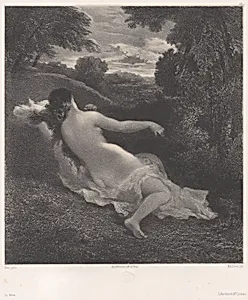
The Dream
Medium
Lithograph
Dimensions
Sheet: 17 1/4 × 11 1/4 in. (43.8 × 28.5 cm)
Classification
Prints
Department
Drawings and Prints
Museum
Metropolitan Museum of Art, New York, NY
Credit
Museum Accession, transferred from the Library
Accession Number
22.106.36(5–6)
Rights
Public Domain
Tags
Art Historical Context
"The Dream" is a captivating lithograph created around 1849–62 by French artist Célestin Nanteuil, with from Narcisse-Virgile de la Peña, and printed by Bertauts at P. Cadet's workshop in Paris. Measuring 17¼ × 11¼ inches, this print exemplifies mid-19th-century Frenchism, a period when artists explored sensuality, fantasy, and the female form. Housed in the Metropolitan Museum of Art's and Prints department, it transferred from the Library, its dual appeal as both fine art and illustrative work. Lithography, the medium here, revolutionized printmaking by allowing artists to draw directly on limestone with greasy crayon, producing rich tonal gradations that mimicked charcoal sketches or paintings. Nanteuil, known for his delicate line work and Orientalist themes, likely captured Diaz de la Peña's influence— the Barbizon painter famed for lush, idealized nudes amid dreamlike settings. The tag "Female Nudes" suggests a reclining or visionary female figure, evoking the era's fascination with reverie and eroticism, inspired by literature like Victor Hugo's works. This print offers a window into how 19th-century innovations democratized art, making intimate, high-quality reproductions accessible beyond oil paintings. Visitors will appreciate its subtle textures and emotional depth, a testament to lithography's enduring legacy in bridging painting and print.