
The Drinker
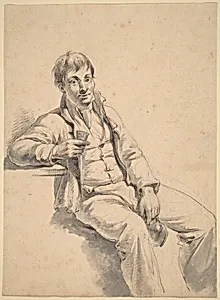
Medium
graphite and black chalk with gray wash on laid paper
Dimensions
sheet: 28.1 × 20.5 cm (11 1/16 × 8 1/16 in.)
Classification
Drawing
Department
CG-W
Museum
National Gallery of Art, Washington, D.C.
Credit
John Davis Hatch Collection
Accession Number
1979.20.67
Rights
Public Domain
Art Historical Context
**The Drinker** (1820s) by Charles Wesley captures a moment of everyday life in early 19th-century America through a delicate drawing in graphite, black chalk, and gray wash on laid paper. Measuring just 28.1 × 20.5 cm, this intimate study exemplifies Jarvis's skill as a Philadelphia-based artist and engraver, who trained under portraitist John Neagle and contributed to the burgeoning American genre tradition. Influenced by European masters like of the Dutch Golden Age, Jarvis depicted ordinary figures—here, a solitary drinker—highlighting social themes with a touch of realism and humanity. The mixed-media technique is particularly noteworthy: graphite provides precise lines for facial details and folds in clothing, while black chalk builds rich shadows, and gray wash adds atmospheric depth, creating a subtle tonal range on the textured laid paper. This approach was common for preparatory sketches but stands alone as a finished work, showcasing Jarvis's versatility before photography revolutionized portraiture. Housed in the National Gallery of Art's John Davis Hatch Collection (Department CG-W), **The Drinker** reflects America's cultural shift toward celebrating the working class amid rapid urbanization. Its quiet intensity invites visitors to ponder the stories behind simple lives, bridging fine art with the familiar. A gem for fans of early American draftsmanship! (198 words)
About the Artist
Charles Wesley Jarvis · 1812–1868
**Charles Wesley Jarvis (1812–1868)** was an American portrait painter and the second son of the renowned New York artist John Wesley Jarvis. Born in New York City, he followed directly in his father’s footsteps as a portraitist during the mid-nineteenth century. As the son of one of the leading portrait painters of the early republic, Jarvis trained in the family studio and absorbed the techniqu...