
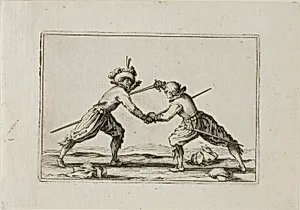
The Duel with Swords, from The Caprices
c. 1622
Medium
Etching on ivory laid paper
Dimensions
Image/plate: 5.6 × 8.1 cm (2 1/4 × 3 1/4 in.); Sheet: 7.7 × 11.1 cm (3 1/16 × 4 3/8 in.)
Classification
etching
Department
Prints and Drawings
Museum
Art Institute of Chicago
Accession Number
131517
Rights
Public Domain
About this artwork
Jacques Callot excelled at integrating colorful, often lowbrow details into his elegant etchings. His humorous series The Caprices includes snippets from the daily life of soldiers and peasants alike.
Art Historical Context
Jacques Callot's *The Duel with Swords*, from the series *The Caprices* (c. 1622), captures a tense moment of swordplay in a compact etching that exemplifies the artist's mastery of miniature drama. Created during Callot's prolific period in Florence under Medici patronage, this print belongs to a suite of whimsical yet incisive scenes blending fantasy, satire, and everyday life. At just 5.6 × 8.1 cm, it invites close viewing, revealing the chaotic energy of two figures locked in combat amid swirling lines that evoke the Baroque era's theatrical intensity. Etching on ivory laid paper was Callot's preferred medium, allowing unprecedented detail and tonal range through his innovative use of multiple biting techniques and fine cross-hatching. This small-scale format made his works affordable and collectible, revolutionizing printmaking by democratizing high art for a wider audience beyond nobility. Callot's style—precise yet expressive—bridged Mannerism and early Baroque, influencing later artists like Goya in his own *Caprichos*. Housed in the Art Institute of Chicago's Prints and Drawings department, this piece reflects 17th-century Europe's fascination with duels as symbols of honor and folly, offering museum visitors a window into Callot's sharp social commentary wrapped in exquisite craftsmanship.
About the Artist
Jacques Callot · 1592–1635
Jacques Callot (1592–1635) was a French printmaker and draftsman from the Duchy of Lorraine, widely regarded as one of the first great artists to practice the graphic arts exclusively. His more than 1,400 etchings chronicled the breadth of 17th-century life, from Medici court festivities to the brutal realities of warfare. Callot revolutionized etching through technical innovations including the é...