
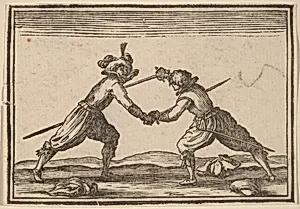
Duel with Swords
Medium
woodcut on laid paper
Dimensions
sheet (trimmed to block): 5.8 × 8.3 cm (2 5/16 × 3 1/4 in.)
Classification
Department
CG-E
Museum
National Gallery of Art, Washington, D.C.
Credit
R.L. Baumfeld Collection
Accession Number
1969.15.221
Rights
Public Domain
Art Historical Context
**Duel with Swords** (1621) is a captivating woodcut on laid paper by Edouard Eckman, created after the renowned French printmaker Jacques Call. Measuring just 5.8 × 8.3 cm—trimmed precisely to the block—this diminutive print packs dramatic intensity into a tiny format. Part of the National Gallery of's R.L. Baumfeld Collection (Department CG-E), it exemplifies early 17th-century printmaking techniques, where woodcuts allowed for bold, high-contrast images produced through relief printing on handmade laid paper, recognizable by its subtle chain lines. Jacques Callot, a master of intricate detail and dynamic compositions, influenced Eckman's reproduction during a time of social upheaval in Europe. The scene depicts a tense sword duel, evoking the era's rigid codes of honor and chivalric violence, prevalent among nobility amid the Thirty Years' War's shadow. Callot's style—marked by fluid lines and crowded narratives—transitions Mannerism into Baroque expressiveness, making even small works like this feel alive with motion and emotion. This print's cultural significance lies in its role as an accessible art form, disseminating dramatic vignettes to a wide audience. Woodcuts like this preserved fleeting moments of human conflict, offering museum visitors a window into 17th-century sensibilities where personal valor clashed with emerging societal norms. A testament to technical virtuosity, it invites close inspection to uncover its finely carved drama.
About the Artist
Edouard Eckman after Jacques Callot
Edouard Eckman, a Flemish printmaker born around 1600, remains a somewhat enigmatic figure in art history, with his early life not well documented. Little is known about his training or formal education, though his oeuvre suggests familiarity with the vibrant printmaking traditions of the early Baroque period in Northern Europe. Active primarily in the second decade of the seventeenth century, Eck...