
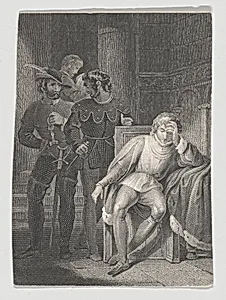
The Duke of Clarence Asleep in the Tower, as Brackenbury Leaves (Shakespeare, Richard III, Act 1, Scene 4)
Medium
Etching and engraving
Dimensions
Sheet: 3 7/16 × 2 9/16 in. (8.8 × 6.5 cm)
Classification
Prints
Department
Drawings and Prints
Museum
Metropolitan Museum of Art, New York, NY
Credit
Gift of Harriet McDonald, 1941
Accession Number
41.91.168
Rights
Public Domain
Tags
Art Historical Context
In this intricate etching and engraving from 1825–40, Henry Corbould captures a tense moment from William Shakespeare's *Richard III*, 1, Scene 4: "The Duke of Clarenceleep in the Tower, Brackenbury Leaves." by Corbould and masterfully engraved by Charles Rolls, the small-scale print (just 3 7/16 × 2 9/16 inches) depicts the vulnerable Duke of Clarence dozing in his prison cell, oblivious to his impending doom as the warden Brackenbury departs. tragedy, written around 1593, draws from the real historical figure George Plantagenet, Duke of Clarence, brother to King Edward IV and victim of a infamous wine-butt drowning ordered by Richard. This artwork reflects the 19th-century British fascination with Shakespearean drama, a cultural phenomenon that spurred countless illustrations to bring the Bard's words to life for wider audiences. Corbould, known for his historical and literary scenes, and Rolls, a skilled printmaker, employed etching for fine lines and engraving for rich tonal depth, allowing affordable reproduction of dramatic narratives. Housed in the Metropolitan Museum of Art's Drawings and Prints department (gift of Harriet McDonald, 1941), it exemplifies how printmaking democratized art, blending literature, history, and visual storytelling in an era of Romantic theatricality. Imagine the hush of the Tower as Clarence slumbers— a poignant reminder of betrayal's shadow.
About the Artist
Henry Corbould|Charles Rolls|William Shakespeare · 1787–1844
Comment on works: History; Literary illustrations; Genre