
The Play-Within-A-Play
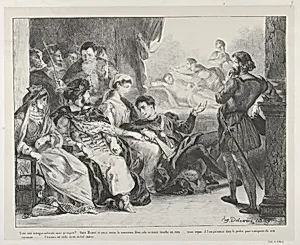
Medium
Lithograph; second state of three
Dimensions
Sheet: 13 5/8 x 10 7/8 in. (34.6 x 27.6 cm) Image: 9 3/4 x 12 11/16 in. (24.8 x 32.2 cm)
Classification
Prints
Department
Drawings and Prints
Museum
Metropolitan Museum of Art, New York, NY
Credit
Rogers Fund, 1922
Accession Number
22.56.10
Rights
Public Domain
Tags
Art Historical Context
In the heart of the Romantic era, Eugène Del, a master of dramatic expression, created *The Play-Within-APlay* in 1835 as a lithograph—the second state of three. evocative print draws from William Shakespeare's *Hamlet*, the tense "play-within-a" scene where Hamlet stages a performance to expose his uncle Claudius's guilt. Delacroix, renowned for his bold use of color and emotion in painting, channeled that intensity into black-and-white lithography, blending his French Romantic flair with Shakespeare's timeless tragedy. The composition features men and women in period attire, their gestures alive with intrigue and psychological depth. Lithography allowed Delacroix to achieve rich tonal contrasts and fluid lines, mimicking the spontaneity of drawing while enabling multiple impressions. Measuring 13⅝ × 10⅞ inches, this sheet from the Metropolitan Museum of Art's Drawings and Prints collection exemplifies 19th-century innovations in printmaking, making high art accessible beyond oil canvases. Acquired via the Rogers Fund in 1922, it reflects the era's fascination with Shakespearean drama on the Continent. This work highlights Romanticism's embrace of literature and theater, inviting viewers to ponder themes of deception and revenge. A captivating window into Delacroix's versatility, it remains a gem for Shakespeare enthusiasts and print lovers alike.
About the Artist
Eugène Delacroix|William Shakespeare|Villain · 1798–1863
Eugène Delacroix (1798–1863) stands as the defining figure of French Romanticism and a pivotal bridge to modernism. Born in Charenton-Saint-Maurice near Paris, he came from distinguished lineage—his mother descended from the prestigious Oeben-Riesener furniture dynasty, while persistent speculation suggested the statesman Talleyrand may have been his biological father, a theory supported by physic...