
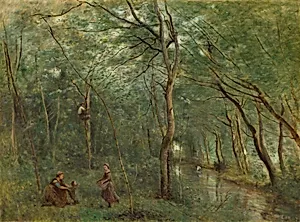
The Eel Gatherers
1860/1865
Medium
oil on canvas
Dimensions
overall: 60.5 x 81.5 cm (23 13/16 x 32 1/16 in.) framed: 80 x 106 x 7 cm (31 1/2 x 41 3/4 x 2 3/4 in.)
Classification
Painting
Department
CF
Museum
National Gallery of Art, Washington, D.C.
Credit
Gift of Mr. and Mrs. P.H.B. Frelinghuysen in memory of her father and mother, Mr. and Mrs. H.O. Havemeyer
Accession Number
1943.15.1
Rights
Public Domain
Art Historical Context
Jean-Baptiste-Camille Cor's *The Eel Gatherers* (c. 1860–1865) captures a serene moment in rural France, where humble figures wade through shallow waters to collect eels. Painted in oil on canvas (60.5 x 81.5 cm), this exemplifies Corot's mature style as a leading figure in the Barbizon School, blending meticulous observation of nature with poetic lyricism. By the 1860s, Corot had refined touch, using loose brushwork and subtle tonal gradations to evoke the soft, diffused light filtering through misty atmospheres—a technique that bridged Romanticism and the emerging Impressionism. Historically, the painting reflects mid-19th-century fascination with everyday peasant life, moving away from idealized classical scenes toward authentic landscapes. Corot's emphasis on transience and harmony with nature underscores the era's shifting artistic priorities, influenced by plein-air sketching during his travels. This intimate scale invites viewers into a tranquil world, highlighting his mastery of sfumato-like effects for depth and mood. Now housed in the National Gallery of Art as a gift from Mr. and Mrs. P.H.B. Frelinghuysen, *The Eel Gatherers* remains a testament to Corot's enduring influence. It's a perfect gem for contemplating the quiet beauty of the ordinary. (198 words)
About the Artist
Jean-Baptiste-Camille Corot · 1796–1875
Jean-Baptiste-Camille Corot, born on July 16, 1796, in Paris to a prosperous bourgeois family—his father a former wig-maker turned draper and his mother a successful milliner—was initially apprenticed in the textile trade but pursued art from his mid-twenties with family support. He studied under the neoclassical landscapist Achille Etna Michallon in 1821–1822, who taught him to sketch outdoors in...