
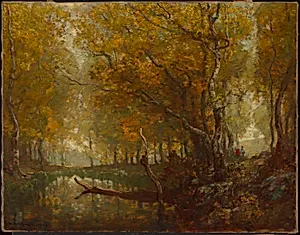
Bradbury's Mill Pond, no. 2
Medium
Painting
Classification
Painting
Department
Smithsonian Collection
Museum
Smithsonian American Art Museum
Credit
Smithsonian American Art Museum, Gift of William T. Evans
Accession Number
1909.7.56
Rights
Public Domain
Tags
Art Historical Context
Henry Ward Ranger's *Bradbury's Mill, no. 2* (1903) invites viewers into a tranquil corner of the American landscape, capturing a serene mill pond nestled amid dense forest and shimmering waters. Small figures dot the scene, adding a human touch to the vast natural expanse, evoking a sense of quiet harmony between people and their environment. As an oil painting, it exemplifies the medium's ability to layer rich textures and subtle light effects, drawing the eye deeper into its poetic depths. Ranger, a leading figure in American Tonalism—a movement bridging Impressionism and Realism—employed a muted palette of earthy greens, grays, and browns to create atmospheric mood over vivid color. Active in the late 19th and early 20th centuries, he drew inspiration from the Barbizon school, emphasizing nature's contemplative beauty. This work reflects Tonalism's cultural significance during a time of rapid industrialization, offering an idealized retreat into America's pastoral heritage. Generously gifted to the Smithsonian American Art Museum by collector William T. Evans, the painting remains a cherished highlight of the collection, reminding us of Ranger's enduring legacy in celebrating the subtle poetry of the everyday landscape.
About the Artist
Henry Ward Ranger · 1858–1916
Henry Ward Ranger was born in 1858 in Syracuse, New York, and grew up to become one of the leading American landscape painters of the late nineteenth and early twentieth centuries. He received his early training in the United States before traveling extensively in Europe, where he spent significant time studying in Holland and England. The Dutch Barbizon painters — particularly the Hague School ar...