
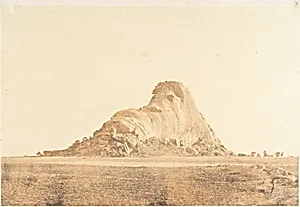
The Elephant Rock
January–February 1858
Medium
Albumen silver print from waxed paper negative
Dimensions
Image: 23.7 x 35.5 cm (9 5/16 x 14 in.) Mount: 45.3 x 57.4 cm (17 13/16 x 22 5/8 in.)
Classification
Photographs
Department
Photographs
Museum
Metropolitan Museum of Art, New York, NY
Credit
Gilman Collection, Purchase, Cynthia Hazen Polsky Gift, 2005
Accession Number
2005.100.381.1.1
Rights
Public Domain
Art Historical Context
Linnaeus Tripe, a British army officer and pioneering photographer, created this striking image during his travels through southern India in early 1858. Known for his methodical documentation of landscapes, architecture, and monuments under the auspices of the East India Company, Tripe often sought out striking natural forms that captured the imagination. *The Elephant Rock* exemplifies his eye for dramatic geological features, transforming an imposing boulder—shaped by nature into an elephant-like silhouette—into a compelling visual study of form and texture against the Indian terrain. The photograph was produced using the albumen silver print process from a waxed paper negative, a technique Tripe refined to achieve remarkable detail and tonal range in large-format images. This medium allowed for the subtle gradations of light and shadow that emphasize the rock’s rugged contours, while the waxed negative helped preserve delicate details during the long exposures required in the field. Created shortly after the Indian Rebellion of 1857, the work reflects the era’s blend of scientific exploration and colonial documentation. Today, the print stands as an early masterpiece of landscape photography, bridging artistic vision with historical record. Its presence in the Metropolitan Museum’s collection highlights Tripe’s lasting contribution to the medium, inviting viewers to appreciate both the natural wonder he captured and the technical ingenuity of mid-nineteenth-century photography.
About the Artist
Linnaeus Tripe · 1822–1902
Linnaeus Tripe (1822–1902), born in Devonport, England, as the ninth of twelve children to Mary and Cornelius Tripe, pursued a military career influenced by his sister Emily's marriage to an army colonel. Joining the East India Company's Madras Infantry as a cadet in 1838, he rose to lieutenant in southern India by 1840 and captain in Bangalore by 1854. Extended leave in England from 1850 due to i...