
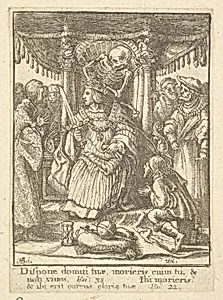
The Emperor, from the Dance of Death
[1651] late 18th century printing
Medium
Etching; second state of four
Dimensions
Sheet: 2 15/16 × 2 1/8 in. (7.5 × 5.4 cm)
Classification
Prints
Department
Drawings and Prints
Museum
Metropolitan Museum of Art, New York, NY
Credit
The Elisha Whittelsey Collection, The Elisha Whittelsey Fund, 1951
Accession Number
51.501.2116
Rights
Public Domain
Tags
Art Historical Context
In Hans Holbein the Younger's iconic *Dance of Death* series, created around 1523–26 during the Northern Renaissance, "The Emperor" captures the timeless theme of mortality's inevitability. A skeletal figure of Death boldly seizes the crowned emperor, who clutches his orb and scepter amid a grand architectural hall lined with soldiers. This etching, reproduced by Wenceslaus Hollar in 1651 and printed in the late 18th century, exemplifies the *Danse Macabre* motif—a medieval allegory popularized after the Black Death—that levels all social ranks, reminding even the mightiest rulers of their fragility. Holbein, a masterful draftsman known for his precise woodcut designs, infused the series with stark moral symbolism and intricate details, influencing generations of printmakers. Hollar's etching, in its second state of four, showcases the medium's virtuosity: fine lines and tonal gradations convey texture in armor, fabrics, and bone, making complex compositions portable and reproducible. At just under 3 inches tall, this intimate print from the Metropolitan Museum of Art's Elisha Whittelsey Collection was ideal for personal reflection. Culturally, the image underscored Renaissance humanism's embrace of *memento mori* ("remember death"), urging humility amid Europe's turbulent wars and plagues. Today, it fascinates as a poignant snapshot of power's illusion, inviting visitors to ponder our own dance with destiny.
About the Artist
Wenceslaus Hollar|Hans Holbein the Younger · 1607–1677
Wenceslaus Hollar (1607-1677) was a prolific Bohemian etcher who became one of the most accomplished printmakers of the seventeenth century. Born in Prague, he trained under Matthäus Merian in Frankfurt before entering the service of Thomas Howard, Earl of Arundel, in 1636. Hollar spent most of his career in England, where he produced approximately 2,740 etchings documenting an extraordinary range...