
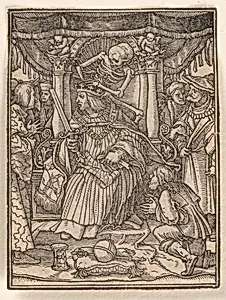
The Emperor, from The Dance of Death
ca. 1526, published 1538
Medium
Woodcut
Dimensions
sheet: 2 9/16 x 1 15/16 in. (6.5 x 4.9 cm)
Classification
Prints
Department
Drawings and Prints
Museum
Metropolitan Museum of Art, New York, NY
Credit
Rogers Fund, 1919
Accession Number
19.57.7
Rights
Public Domain
Tags
Art Historical Context
In Hans Holbein the Younger's iconic series *The Dance of Death*, "The Emperor" (ca. 1526, published 1538 captures the Renaissance fascination with mortality through a masterful woodcut, measuring just 2 9/16 x 1 15/16 inches. Designed by the German artist Holbein—a leading Northern Renaissance figure known for his precise line work—and expertly cut by Hans Lützelburger, print exemplifies the collaborative craft of 16th-century printmaking. Woodcuts like this allowed for affordable reproduction, spreading moral messages across Europe amid plagues and social upheaval. The scene depicts a skeletal Death boldly leading a crowned emperor in a macabre dance, stripping away imperial splendor to reveal human vulnerability. Surrounded by courtiers and symbols of power, the emperor clutches his orb and scepter futilely, embodying the medieval *danse macabre* tradition: Death unites all ranks, from peasants to rulers, in inevitable equality. This poignant reminder of *memento mori* resonated in Reformation-era Europe, where Holbein's stark, expressive lines heightened the drama. Housed in the Metropolitan Museum of Art's Drawings and Prints department (Rogers Fund, 1919), this tiny yet monumental work showcases the woodcut's technical brilliance—intricate shading and dynamic composition achieved through subtle relief carving—making profound philosophical ideas accessible to everyday viewers.