
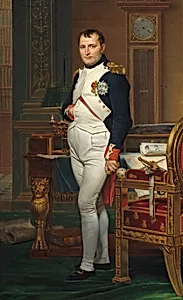
The Emperor Napoleon in His Study at the Tuileries
Medium
oil on canvas
Dimensions
overall: 203.9 × 125.1 cm (80 1/4 × 49 1/4 in.) framed: 243.9 x 165.1 x 15.2 cm (96 x 65 x 6 in.) framed weight: 63.957 kg (141 lb.)
Classification
Painting
Department
CF
Museum
National Gallery of Art, Washington, D.C.
Credit
Samuel H. Kress Collection
Accession Number
1961.9.15
Rights
Public Domain
Art Historical Context
Step into the grand study of the Tuileries Palace with Jacques-Louis David's masterful 1812 portrait, *The Emperor Napoleon in His Study the Tuileries*. in oil on canvas—a medium ideal for capturing intricate details and luminous textures—this monumental work (over 80 inches tall) depicts Napoleon Bonaparte at 4 a.m., diligently at work amid towering bookshelves, scattered maps, and a glowing globe. David, the preeminent Neoclassical artist and Napoleon's court painter, crafted this image to portray the emperor not as a distant monarch, but as a tireless scholar-statesman, evoking the disciplined virtue of ancient Roman leaders. Historically, the painting emerged amid Napoleon's grueling Russian campaign, serving as propaganda to dispel rumors of imperial indolence. David's precise brushwork and dramatic chiaroscuro lighting heighten the sense of quiet intensity, with Napoleon's green uniform and polished boots rendered in hyper-realistic detail, symbolizing order and authority. The open *Code Napoléon* on his table underscores his legacy as a legal reformer. Today, housed in the National Gallery of Art's Samuel H. Kress Collection, this iconic piece endures as a testament to Neoclassicism's blend of idealism and realism, inviting us to ponder power's human face.
About the Artist
Jacques-Louis David · 1748–1825
Jacques-Louis David, born on August 30, 1748, in Paris, emerged as the preeminent French painter of Neoclassicism, a movement emphasizing austere lines, moral clarity, and classical antiquity as antidotes to Rococo frivolity. Orphaned young after his father's death in a duel, he was raised by prosperous architect uncles and educated at the Collège des Quatre-Nations. Defying family expectations, D...