
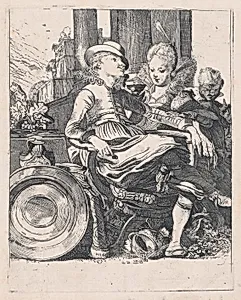
The Enamored Couple: Lucelle and Ascagnes
Medium
Etching
Dimensions
Sheet: 10 15/16 × 7 9/16 in. (27.8 × 19.2 cm) Plate: 8 1/8 × 6 7/16 in. (20.7 × 16.3 cm)
Classification
Prints
Department
Drawings and Prints
Museum
Metropolitan Museum of Art, New York, NY
Credit
Harris Brisbane Dick Fund, 1932
Accession Number
32.17.7
Rights
Public Domain
Tags
Art Historical Context
Willem Pietersz. Buytewech's *The Enamored Couple: Lucelle and Ascagnes* (1616) captures a tender moment between two elegantly dressed figures, rendered in the intimate scale of an etching. Buytewech, a Dutch artist from Haarlem (1591–1624), was among the first to depict modern life with stylish, elongated figures in contemporary fashion, foreshadowing the Dutch Golden Age's genre painting tradition. This print, measuring just over 10 by 7 inches on the sheet, exemplifies his skill in etching—a technique where acid bites into a metal plate to create fine, expressive lines—allowing detailed textures in clothing and expressive faces to shine through in multiples. Created during the early 17th century, when the Netherlands was buzzing with prosperity and cultural innovation, the work reflects emerging interests in romantic couples and everyday elegance. The named protagonists, Lucelle and Ascagnes, evoke a playful, literary charm, blending courtship themes with Buytewech's signature wit and refinement. As a print from the Metropolitan Museum of Art's Drawings and Prints collection (acquired via the Harris Brisbane Dick Fund in 1932), it highlights etching's role in democratizing art, making sophisticated scenes accessible beyond paintings. Visitors will appreciate how this gem bridges mannerist grace and emerging realism, inviting a closer look at love's subtle gestures amid opulent attire.