
Un Thé de Douairières (The Dowagers' Tea Party)
1879/1880
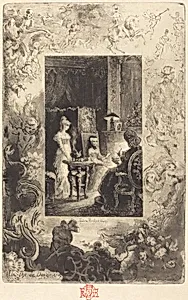
Medium
etching, drypoint, and aquatint (dust ground and spirit ground) in black on Japanese paper
Dimensions
plate: 17.5 x 11.4 cm (6 7/8 x 4 1/2 in.) sheet: 23.7 x 16.5 cm (9 5/16 x 6 1/2 in.)
Classification
Department
CG-E
Museum
National Gallery of Art, Washington, D.C.
Credit
Helena Gunnarsson Buhot Collection
Accession Number
1995.54.42
Rights
Public Domain
Art Historical Context
### Un Thé de Douairières (Theagers' Tea Party) Created around 1879/1880 by French printmaker Félix-Hilaireot, *Un Thé de Douair* captures a whimsical, satirical glimpse into the refined yet stuffy world of high-society tea gatherings. Buhot, a master of 19th-century etching renowned for his intricate and atmospheric prints, depicts a group of elderly dowagers in a moment of polite conversation, evoking the Belle Époque's fascination with social rituals. His work bridges Impressionism's everyday scenes with the precision of traditional printmaking, infusing humor into the bourgeoisie leisure class. This print showcases Buhot's technical brilliance through etching for fine lines, drypoint for rich, velvety burrs, and aquatint using innovative dust and spirit grounds to achieve subtle tonal gradations and textures. Printed in black ink on delicate Japanese paper—a nod to the era's Japonisme craze—the medium enhances the image's luminous depth and intricate details, from lace-trimmed gowns to steaming teacups. Measuring just 17.5 x 11.4 cm on the plate, its small scale invites close viewing, rewarding observers with Buhot's signature layered complexity. Housed in the National Gallery of Art's Helena Gunnarsson Buhot Collection, this piece highlights Buhot's legacy as a "painter-engraver," pushing printmaking boundaries during a time when photography challenged traditional media. It's a delightful window into late-19th-century French culture, blending elegance, satire, and artistry. (198 words)
About the Artist
Félix-Hilaire Buhot · 1847–1898
Félix-Hilaire Buhot was born on July 9, 1847, in Valognes, a small town in Normandy, France, into a modest family—his father a wine merchant and his mother a seller of women's clothes. Orphaned by age seven after losing both parents and his maternal grandmother, he was raised by relatives, including a godfather, and received an early introduction to drawing from his adopted mother's nephew. In 186...