
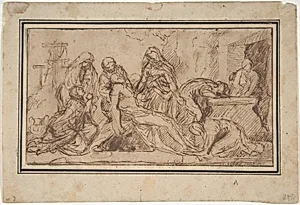
The Entombment
ca. 1656–57
Medium
Pen and brown ink
Dimensions
3 7/16 x 6 1/8 in. (8.8 x 15.6 cm.)
Classification
Drawings
Department
Drawings and Prints
Museum
Metropolitan Museum of Art, New York, NY
Credit
Rogers Fund, 1961
Accession Number
61.123.1
Rights
Public Domain
Tags
Art Historical Context
Nicolas Poussin'sThe Entombment*, around 1656–57, captures a poignant moment from the biblical Passion of Christ: the lowering of Jesus's body into the tomb the Crucifixion. This intimate pen and brown ink drawing, measuring just 3 7/16 x 6 1/8 inches, exemplifies Poussin's mastery as a draftsman. Housed in the Metropolitan Museum of Art's Drawings and Prints department (quired via the Rogers Fund 1961), it invites visitors to appreciate the delicate precision of its lines amid the drama of religious narrative. As a leading figure in 17th-century French classicism, Poussin drew inspiration from ancient Roman art and Renaissance masters like Raphael, emphasizing balanced compositions, emotional restraint, and moral clarity. Here, the brown ink technique—likely employing fine hatching and cross-hatching—allows for subtle modeling of figures and drapery, conveying solemnity and humanity in a compact format. Such drawings were central to Poussin's methodical process, serving as preparatory studies that refined his grand painted compositions. This work offers a window into Baroque-era devotion and artistic rigor, reminding us how Poussin's intellectual approach elevated religious subjects into timeless meditations on grief and redemption. A gem for drawing enthusiasts, it highlights the enduring power of sketches to evoke profound empathy.
About the Artist
Nicolas Poussin · 1594–1665
Nicolas Poussin, born in June 1594 near Les Andelys in Normandy, emerged from a family of local distinction whose modest means and parental opposition could not deter his artistic calling. He received his initial training under the itinerant painter Quentin Varin in Rouen around 1611–12, absorbing lessons in storytelling, precise facial expressions, and rich colors, though without a formal long-te...