
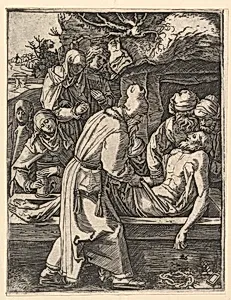
The Entombment
ca. 1500–1534
Medium
Engraving; second state of three
Dimensions
Sheet: 5 1/16 × 3 15/16 in. (12.9 × 10 cm)
Classification
Prints
Department
Drawings and Prints
Museum
Metropolitan Museum of Art, New York, NY
Credit
Gift of Henry Walters, 1917
Accession Number
17.37.261
Rights
Public Domain
Tags
Art Historical Context
Behold *The Entombment*, poignant engraving capturing the solemn moment of Christ's body being laid to rest, surrounded by grieving men and women. Created around 1500–1534, this work unites the masterful designs of German Renaissance artist Albrecht Dürer the virtuoso engraving skills of Italian printmaker Marcantonio Raimondi. Dürer's intricate compositions, known for their emotional depth and meticulous detail, were brilliantly reproduced by Raimondi, elevated engraving into a medium rivaling painting. This second state of three impressions measures a compact 5 1/16 × 3 15/16 inches, showcasing the technical precision of copperplate engraving—a revolutionary technique in the early 16th century that allowed for fine lines, rich tonal contrasts, and widespread dissemination of images. Such prints bridged Northern and Italian Renaissance styles, making sacred scenes like the Entombment accessible to devout audiences beyond elite patrons. A gift to the Metropolitan Museum of Art from Henry Walters in 1917, this piece from the Drawings and Prints department highlights the era's fusion of faith, artistry, and innovation, inviting visitors to ponder the universal sorrow of loss amid Renaissance humanism.
About the Artist
Marcantonio Raimondi|Albrecht Dürer · 1475–1534
Marcantonio Raimondi (c. 1480–1534), born near Bologna, Italy, emerged as one of the Renaissance's premier engravers, revolutionizing printmaking through his mastery of reproductive techniques. He trained in the workshop of the goldsmith, painter, and niellist Francesco Francia, whose influence is evident in his early engravings, such as the goldsmith-like shading in *Pyramus and Thisbe* (1505), h...