
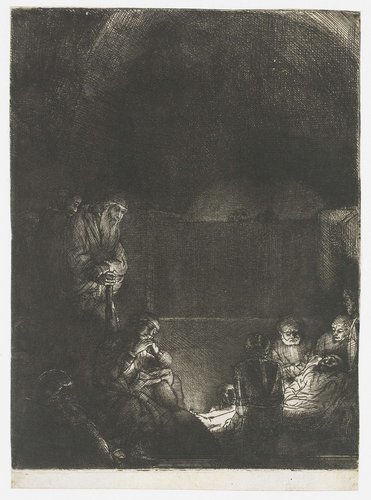
The Entombment
ca. 1654
Medium
etching
Dimensions
160; 211
Rights
Public Domain
About this artwork
height 211 mm x width 160 mm
Art Historical Context
Rembrandt van Rijn'sThe Entombment* (ca. 1654) captures a poignant moment from the New Testament: the sorrowful lowering of Christ's body into the tomb following the Crucifixion. Created during the Dutch Golden Age, this etching reflects Rembrandt's profound engagement with biblical narratives, blending deep spirituality with human emotion. At a compact 211 mm high by 160 mm wide, the intimate scale invites close contemplation, much like a personal devotional object. As a master of Baroque art, Rembrandt elevated etching—a printmaking technique using acid to bite lines into a metal plate—into a medium rivaling painting. Here, he employs his signature chiaroscuro, with dramatic contrasts of light and shadow emerging from inky darkness, achieved through delicate burr (raised metal edges) that yields velvety textures. This innovation allowed for subtle tonal gradations, making prints like this highly sought after by 17th-century collectors. Historically significant, *The Entombment* showcases Rembrandt's mature style amid personal hardships, including mounting debts. Its cultural resonance endures, embodying the era's fascination with light as divine revelation and empathy in suffering, offering visitors a window into 17th-century Amsterdam's artistic brilliance.
About the Artist
Rembrandt van Rijn · 1606–1669
Rembrandt Harmenszoon van Rijn (1606–1669) stands as one of the greatest visual artists in the history of Western art and the most important Dutch painter of the 17th century. Born in Leiden to a prosperous miller's family, Rembrandt transformed painting through his revolutionary use of light and shadow, his psychological depth in portraiture, and his elevation of etching to a fine art. His approx...