
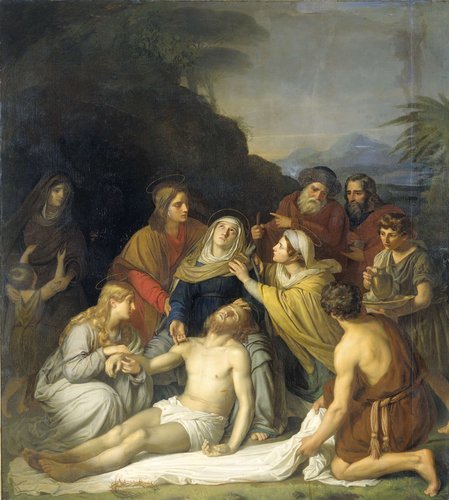
The Entombment
Medium
oil on canvas
Dimensions
330; 290
Rights
Public Domain
About this artwork
signature and date: ‘C. Kruseman f. Hagae 1830’
Art Historical Context
Cornelis Kruseman'sThe Entombment*1830) captures a pivotal moment from the Passion of Christ: the solemn lowering of Jesus's body into the tomb, surrounded by grieving figures like the Virgin Mary and disciples. Signed and dated "C. Kruseman f. Hagae 1830," this monumental oil on canvas—measuring over 3 meters high and nearly 3 wide—was painted in The Hague, reflecting the artist's deep ties to Dutch artistic circles during the early 19th century. Kruseman, a leading Dutch history painter influenced by Romanticism, infused the scene with emotional depth and dramatic lighting, hallmarks of the era's revival of grand religious narratives. Oil on canvas allowed for rich textures and luminous effects, evoking the pathos of earlier masters like Rembrandt while aligning with the Belgian-Dutch Romantic tradition. Its scale suggests it was destined for a public or ecclesiastical space, underscoring faith's cultural role amid post-Napoleonic stability. Housed in the Rijksmuseum, this work exemplifies Kruseman's skill in blending historical reverence with heartfelt drama, offering visitors a poignant glimpse into 19th-century devotion and artistic ambition.
About the Artist
Cornelis Kruseman
Portrait painter who also did Italianate folk scenes, history paintings, and biblical scenes. He painted in a highly finished monumental academic style. The notes he made on his first trip to Italy were published. Comment on works: history; genre; portrait