
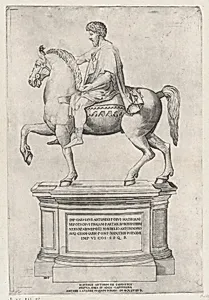
The Equestrian Statue of Marcus Aurelius on the Capitol
Medium
Engraving; first state
Dimensions
Sheet (trimmed): 14 3/16 × 9 1/2 in. (36.1 × 24.2 cm) Mount: 18 9/16 × 13 3/4 in. (47.1 × 35 cm)
Classification
Prints
Department
Drawings and Prints
Museum
Metropolitan Museum of Art, New York, NY
Credit
Harris Brisbane Dick Fund, 1953
Accession Number
53.600.855
Rights
Public Domain
Tags
Art Historical Context
Welcome to the Metropolitan Museum of Art's Drawings and Prints collection, where we encounter *The Equestrian Statue of Marcuslius on the Capitol* (1548), an exquisite engraving by Nicolas Beatrizet. This first-state impression captures the iconic bronze statue of the Roman Emperor Marcus Aureliusr. 161–180 CE), the Stoic philosopher-king, as it stood prominently on Rome's Capitoline Hill during the Renaissance. Created amid a fervent revival of classical antiquity, the print preserves the statue's majestic profile—emperor poised confidently astride his rearing horse—before it was relocated in 1538 to safeguard it from urban encroachment. Beatrizet, a French engraver active in mid-16th-century Rome, masterfully employed the burin technique, incising fine lines into a copper plate to achieve remarkable depth, texture, and chiaroscuro effects. Engravings like this were revolutionary for disseminating images of ancient masterpieces to scholars, collectors, and artists across Europe, fueling the Renaissance fascination with Roman heritage. At 14 3/16 × 9 1/2 inches (trimmed), this intimate yet grand work highlights the statue's dynamic composition, with flowing drapery and anatomical precision that inspired later equestrian monuments. A testament to cultural continuity, it bridges ancient Rome and the modern era, reminding us of Marcus Aurelius's enduring legacy as both ruler and moral thinker. Acquired through the Harris Brisbane Dick Fund in 1953, this print invites you to ponder the timeless power of leadership immortalized in metal and ink.
About the Artist
Nicolas Beatrizet · 1515–1566
Nicolas Beatrizet, born around 1515 in Lunéville, Lorraine (then part of the Holy Roman Empire), emerged as one of the most prolific French engravers of the 16th century. Little is known about his early life and training, with no records of specific teachers or apprenticeships, though regional influences from German and Italian printmaking likely shaped his skills before he arrived in Rome around ...