
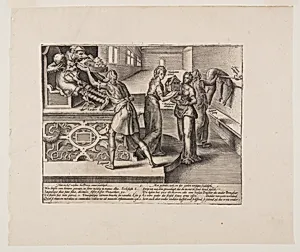
The Expense of Litigation, from Litis Abusus (The Abuses of the Law)
c. 1576
Medium
Engraving on ivory laid paper
Dimensions
Plate: 18.1 × 23 cm (7 3/16 × 9 1/16 in.); sheet: 27.5 × 33 cm (10 7/8 × 13 in.)
Classification
Department
Prints and Drawings
Museum
Art Institute of Chicago
Accession Number
268411
Rights
Public Domain
Art Historical Context
**The Expense of Litigation**, created around 1576 by the renowned Dutch engraver Hendrick Gzius, is a print from his satirical series *Litis Ab (The Abuses of Law)*. This work critiques the burdensome financial toll of prolonged lawsuits in th-century Europe, a when legal disputes were rampant amid social and political upheavals like Dutch Revolt. Goltzius, a pivotal figure in Mannerism, used sharp visual wit to expose societal flaws, making complex commentary accessible through intricate prints. Masterfully executed as an engraving on luxurious ivory laid paper (plate: 18.1 × 23 cm), the technique involved incising fine lines into a metal plate, inking it, and pressing onto paper for precise, reproducible images. Goltzius's virtuosic linework—bold swells and delicate hatches—conveys dramatic contrasts and textured details, elevating prints from mere reproductions to collector's gems. This medium democratized art, allowing wider dissemination of his moralistic narratives. Housed in the Art Institute of Chicago's Prints and Drawings Department, this piece highlights Goltzius's early genius at age 19, foreshadowing his mastery. It remains a cultural touchstone, reminding us how art has long satirized justice's pitfalls, blending artistry with timely critique.
About the Artist
Hendrick Goltzius · 1558–1617
Hendrick Goltzius (1558–1617) was the most celebrated engraver of the Northern Renaissance and a pivotal figure in Dutch Mannerism. Born near the German-Dutch border, Goltzius transformed printmaking into a virtuoso art form through his revolutionary 'swelling line' technique, where the burin was manipulated to create lines of varying thickness that produced unprecedented tonal effects and three-d...