
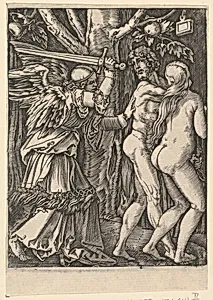
The Expulsion from the Paradise, after Dürer
ca. 1500–1534
Medium
Engraving; second state of three
Dimensions
Sheet: 5 7/16 × 3 7/8 in. (13.8 × 9.9 cm)
Classification
Prints
Department
Drawings and Prints
Museum
Metropolitan Museum of Art, New York, NY
Credit
Gift of Henry Walters, 1917
Accession Number
17.37.237
Rights
Public Domain
Tags
Art Historical Context
Behold *The Expulsion from Paradise, after Dürer*, a masterful engraving by Italian printmaker Marcantonio Raimondi, faithfully reproducing a design by the renowned German Renaissance artist Albrecht Dürer. Created around 1500–1534, this second state of three captures the dramatic biblical moment when Adam and Eve, accompanied by a menacing angel, are cast out of Eden. Measuring just 5 7/16 × 3 7/8 inches, its intimate scale invites close inspection, revealing the nude figures' vulnerability and the loss of innocence central to the Genesis story. Dürer, a pioneer of Northern Renaissance printmaking, elevated engraving to fine art with his precise lines and intricate details, influencing generations. Raimondi, active in early 16th-century Italy, specialized in copying such works, spreading Dürer's vision across Europe through affordable reproductions. This technique—incising metal plates with a burin for inked impressions—allowed unprecedented dissemination of complex imagery, blending German precision with Italian elegance. Housed in the Metropolitan Museum of Art's Drawings and Prints department (gift of Henry Walters, 1917), this print exemplifies Renaissance fascination with human anatomy, divine judgment, and moral tales. Its bold male and female nudes underscore themes of temptation and consequence, making it a poignant window into early modern artistry and spirituality.
About the Artist
Marcantonio Raimondi|Albrecht Dürer · 1475–1534
Marcantonio Raimondi (c. 1480–1534), born near Bologna, Italy, emerged as one of the Renaissance's premier engravers, revolutionizing printmaking through his mastery of reproductive techniques. He trained in the workshop of the goldsmith, painter, and niellist Francesco Francia, whose influence is evident in his early engravings, such as the goldsmith-like shading in *Pyramus and Thisbe* (1505), h...