
The Exterminating Angel (L'ange exterminateur)
1889
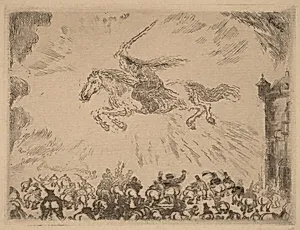
Medium
etching
Classification
Department
CG-E
Museum
National Gallery of Art, Washington, D.C.
Credit
Rosenwald Collection
Accession Number
1964.8.715
Rights
Public Domain
Art Historical Context
James Ensor’s 1889 etching *The Exterminating Angel* captures the Belgian artist at a pivotal moment in his career. Known for blending everyday scenes with the macabre and satirical, Ensor frequently turned to printmaking to explore themes of mortality, isolation, and the supernatural. The title evokes biblical imagery of divine judgment, suggesting an angel of destruction whose presence transforms the ordinary into something ominous and otherworldly. As an etching, the work highlights Ensor’s technical skill in creating sharp lines and rich tonal contrasts on the plate. This medium allowed him to produce intricate, dreamlike compositions that feel both intimate and unsettling, qualities that later influenced Expressionist and Surrealist artists. Created during a period when Ensor was increasingly drawn to masks, skeletons, and social critique, the print stands as a powerful example of his ability to merge personal vision with broader cultural anxieties about fin-de-siècle Europe. Housed in the National Gallery of Art’s Rosenwald Collection, this work invites viewers to consider how Ensor used printmaking not merely as reproduction but as a means of amplifying his distinctive voice in late-19th-century art.
About the Artist
James Ensor · 1860–1949
James Ensor (1860–1949) was a Belgian painter and printmaker whose visionary, often grotesque imagery anticipated Expressionism, Surrealism, and much of the avant-garde art of the twentieth century. Born in Ostend to an English father and Flemish mother who ran a curio shop selling seashells, masks, and carnival souvenirs — objects that would pervade his art — Ensor studied at the Brussels Academy...