
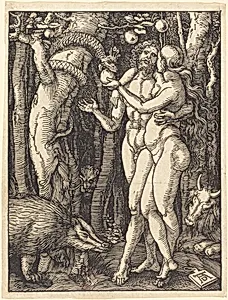
The Fall of Man
probably c. 1509/1510
Medium
woodcut on laid paper
Dimensions
block: 12.8 × 9.7 cm (5 1/16 × 3 13/16 in.) sheet: 13.5 × 10.3 cm (5 5/16 × 4 1/16 in.)
Classification
Department
CG-E
Museum
National Gallery of Art, Washington, D.C.
Credit
Rosenwald Collection
Accession Number
1943.3.3669
Rights
Public Domain
Art Historical Context
Albrecht Dürer, the masterful German artist of the Northern Renaissance, captures the dramatic biblical moment of humanity's original sin in *The Fall of Man*, woodcut likely created around 1509–0. This intimate print depicts Adam and Eve amid the lush Garden of Eden, tempted by the serpent, just before their expulsion—a theme central to Christian theology and Renaissance art. Dürer's lines evoke the tension of temptation and inevitable downfall, blending Northern Gothic detail with Italian Renaissance humanism he encountered on his travels. Printed on laid paper from a small woodblock (just 12.8 × 9.7 cm), this work exemplifies Dürer's revolutionary command of woodcut technique. Unlike earlier crude relief prints, Dürer's fine chiseling achieves engraving-like intricacy, with textured foliage, expressive figures, and subtle tonal effects through cross-hatching. Woodcuts like this allowed affordable dissemination of his genius across Europe, making high art accessible beyond elite patrons. Housed in the National Gallery of Art's Rosenwald Collection, *The Fall of Man* highlights Dürer's enduring legacy as printmaking's pinnacle innovator. Its compact scale belies profound cultural weight, inviting viewers to ponder free will, nature, and divinity in a glance. A timeless reminder of art's power to illuminate the human condition.
About the Artist
Albrecht Dürer · 1471–1528
Albrecht Dürer (1471–1528) stands as the preeminent figure of the Northern Renaissance and arguably the most influential artist in the history of printmaking. Born in Nuremberg on May 21, 1471, and dying in the same city on April 6, 1528, Dürer revolutionized the status of the artist in Northern Europe, transforming printmaking from a commercial craft into an independent fine art and establishing ...