
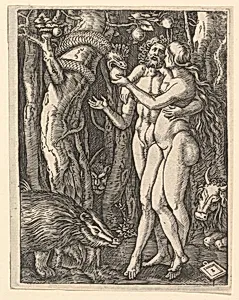
Adam and Eve with apple and serpent
ca. 1500–1534
Medium
Engraving; third state of three
Dimensions
Sheet: 5 3/16 in. × 4 in. (13.2 × 10.1 cm)
Classification
Prints
Department
Drawings and Prints
Museum
Metropolitan Museum of Art, New York, NY
Credit
Gift of Henry Walters, 1917
Accession Number
17.37.236
Rights
Public Domain
Tags
Art Historical Context
This exquisite engraving, *Adam and Eve with Apple and Serpent*, captures the biblical moment of temptation from Genesis, featuring the nude figures of Adam and Eve amid symbolic animals like serpents and boars. Created around 1500–1534, it is a third-state impression by Italian engraver Marcantonio Raimondi after a design by German master Albrecht Dürer. Measuring just 5 3/16 × 4 inches, its intimate scale belies the intricate detail, now housed in the Metropolitan Museum of Art's Drawings and Prints department as a gift from Henry Walters in 1917. Dürer, a cornerstone of the Northern Renaissance, pioneered naturalistic human anatomy and expressive line work in prints, influencing generations. Raimondi, renowned for his precise reproductions of Northern artists, faithfully translated Dürer's vision into engraving—a technique using incised metal plates to produce fine, reproducible images. This "third state" represents the final refinement, with enhanced clarity in shading and texture, allowing widespread dissemination of Renaissance ideals during the early 16th century. Engravings like this democratized art, bridging Italian and Northern styles while exploring themes of sin, temptation, and humanity's fall. Visitors will appreciate its masterful balance of eroticism, symbolism, and technical virtuosity—a timeless window into Renaissance ingenuity.
About the Artist
Marcantonio Raimondi|Albrecht Dürer · 1475–1534
Marcantonio Raimondi (c. 1480–1534), born near Bologna, Italy, emerged as one of the Renaissance's premier engravers, revolutionizing printmaking through his mastery of reproductive techniques. He trained in the workshop of the goldsmith, painter, and niellist Francesco Francia, whose influence is evident in his early engravings, such as the goldsmith-like shading in *Pyramus and Thisbe* (1505), h...