
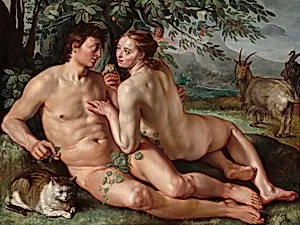
The Fall of Man
Medium
oil on canvas
Dimensions
overall: 104.5 x 138.4 cm (41 1/8 x 54 1/2 in.) framed: 128.9 x 163.2 x 10.2 cm (50 3/4 x 64 1/4 x 4 in.)
Classification
Painting
Department
CNE-B
Museum
National Gallery of Art, Washington, D.C.
Credit
Patrons' Permanent Fund
Accession Number
1996.34.1
Rights
Public Domain
Art Historical Context
Hendrick Goltzius’s *The Fall of Man* (1616) captures the pivotal biblical moment when Adam and Eve yield to temptation in the Garden of Eden. Painted in oil on canvas, the work reflects the artist’s late-career shift from his celebrated engravings to large-scale painting. By this date, Goltzius had already established himself as one of the most technically gifted printmakers of the Dutch Republic, and his paintings often retain the crisp detail and dramatic lighting associated with his graphic work. Created during the early Dutch Golden Age, the canvas speaks to a period when biblical narratives remained central to Northern European art even as secular subjects gained popularity. Goltzius, active in Haarlem, brought his extraordinary command of human anatomy and expressive gesture to the theme, inviting viewers to reflect on human frailty and divine consequence. The generous scale—roughly 104 by 138 centimeters—would have made the scene especially vivid in a domestic or civic setting. As a master of both line and color, Goltzius demonstrates how oil paint could achieve luminous flesh tones and rich textures, qualities that helped elevate painting’s status alongside printmaking in the seventeenth century. Today in the National Gallery of Art, the work continues to draw attention to the enduring power of this foundational story.
About the Artist
Hendrick Goltzius · 1558–1617
Hendrick Goltzius (1558–1617) was the most celebrated engraver of the Northern Renaissance and a pivotal figure in Dutch Mannerism. Born near the German-Dutch border, Goltzius transformed printmaking into a virtuoso art form through his revolutionary 'swelling line' technique, where the burin was manipulated to create lines of varying thickness that produced unprecedented tonal effects and three-d...