
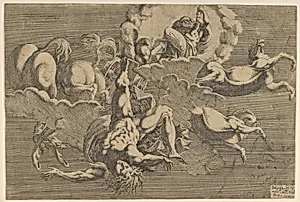
The Fall of Phaeton
Medium
Etching
Dimensions
Sheet (trimmed): 10 1/4 × 15 1/16 in. (26 × 38.2 cm)
Classification
Prints
Department
Drawings and Prints
Museum
Metropolitan Museum of Art, New York, NY
Credit
The Elisha Whittelsey Collection, The Elisha Whittelsey Fund, 1989
Accession Number
1989.1114
Rights
Public Domain
Tags
Art Historical Context
The Fall of Phaeton captures a dramatic moment from classical mythology, in which the young Phaeton loses control of his father Apollo’s sun chariot and plunges to earth. Created in 1545 as an etching, the print reflects the collaborative efforts of Francesco Primaticcio, an Italian artist working at the French court of Fontainebleau, and Antonio Fantuzzi, who translated the design into print. This work belongs to the elegant, elongated Mannerist style fostered at Fontainebleau, where Italian and French artists together produced decorations for royal residences. Etching allowed such dynamic compositions to circulate widely beyond the palace walls, making mythological narratives accessible to collectors and scholars across Europe. The scene’s swirling horses and carriages emphasize movement and tension, inviting viewers to contemplate both the beauty and peril of ambition. Today housed in the Metropolitan Museum of Art’s collection of prints, the sheet preserves the inventive spirit of sixteenth-century court art while demonstrating how printmaking helped shape Renaissance visual culture.
About the Artist
Antonio Fantuzzi|Francesco Primaticcio · 1537–1545
**Antonio Fantuzzi** (active 1537–1550) was an Italian painter and printmaker born in Bologna who played a significant role in the First School of Fontainebleau during the French Renaissance. He worked in a Mannerist style, contributing to the lavish decorations of the Palace of Fontainebleau under royal patronage. Fantuzzi is recorded as a painter at Fontainebleau from 1537 onward, initially on ...