
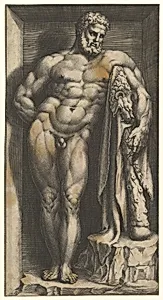
The Farnese Hercules
late 1570s
Medium
Engraving
Dimensions
sheet: 12 11/16 x 6 3/4 in. (32.3 x 17.1 cm) borderline
Classification
Prints
Department
Drawings and Prints
Museum
Metropolitan Museum of Art, New York, NY
Credit
Harris Brisbane Dick Fund, 1958
Accession Number
26.50.1(159)
Rights
Public Domain
Tags
Art Historical Context
Behold the majestic *The Farnese Hercules*, a stunning engraving by the masterful Italian printmaker Giorgio Ghisi, created in the late 0s. This work captures the iconic ancient Roman marble statue of Hercules—discovered in the Baths of Caracalla in1546 and now housed in Naples—depicting the hero in a moment of weary triumph after his labors, club in hand and golden apples at his feet. Ghisi, a leading Mannerist engraver who worked in Antwerp, masterfully translated the sculpture's colossal scale and muscular anatomy into intricate lines on paper, measuring 12 11/16 x 6 3/4 inches. Engravings like this were revolutionary in the Renaissance, democratizing access to classical antiquities that few could see in person. Ghisi's technique—using a burin to incise fine, precise lines into a copper plate—produced rich tonal contrasts and a sense of three-dimensional depth, mimicking the statue's dramatic contrapposto pose. Acquired through the Harris Brisbane Dick Fund in 1958, it resides in the Metropolitan Museum of Art's Drawings and Prints department. This print not only celebrates Hercules as a symbol of superhuman strength and heroism but also reflects the era's obsession with rediscovering Greco-Roman ideals, influencing artists from Michelangelo to Rubens. A true gem for visitors, it bridges antiquity and the print revolution!
About the Artist
Giorgio Ghisi · 1520–1582
Giorgio Ghisi (c. 1520–1582) was one of the most accomplished engravers of the Italian Renaissance, renowned for translating the monumental compositions of Raphael, Giulio Romano, and Michelangelo into the exacting medium of the burin. Born in Mantua, he trained in an environment shaped by the legacy of Giulio Romano's decoration of the Palazzo del Te, and the grandeur of that Mannerist tradition ...