
The Father's Leave-Taking
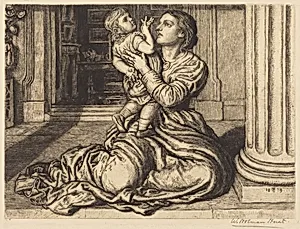
Medium
etching
Dimensions
plate: 19 x 25.4 cm (7 1/2 x 10 in.) sheet: 28.7 x 44 cm (11 5/16 x 17 5/16 in.) overall (mat size): 40.6 x 55.9 cm (16 x 22 in.)
Classification
Department
CG-E
Museum
National Gallery of Art, Washington, D.C.
Credit
Andrew W. Mellon Fund
Accession Number
1978.57.1
Rights
Public Domain
Art Historical Context
William Holman Hunt, a founding member of the Pre-Raphaelite Brotherhood, created this etching in 1879 during the later phase of his career. for his meticulous attention to and moral storytelling, brought the same intensity tomaking as he did his famous paintings. The-Raphaelite emphasis on truthful observation and symbolic depth finds expression here through the intimate scale of the plate. Etching allowed Hunt to reach a broader audience beyond gallery walls. By drawing directly onto the copper plate with fine lines and tonal areas, he achieved the rich textures and emotional nuance typical of his work. This print, measuring roughly 19 by 25 centimeters, exemplifies how Victorian artists used the medium to explore everyday dramas with the same seriousness once reserved for history painting. The title *The Father’s Leave-Taking* hints at themes of family separation and duty that resonated deeply in nineteenth-century Britain. Whether depicting emigration, work, or loss, such scenes invited viewers to reflect on the quiet sacrifices that shaped domestic life during the era.
About the Artist
William Holman Hunt · 1813–1907
**William Holman Hunt (1827–1910)** was an English painter and a founding member of the Pre-Raphaelite Brotherhood, renowned for his meticulous attention to detail, vivid colors, and symbolic depth in both religious and contemporary subjects. Born William Hobman Hunt on 2 April 1827 in Cheapside, London, to a warehouse manager, he initially worked as an office clerk before gaining admission to th...