
The Finger Game
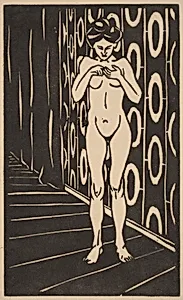
Medium
woodcut in black ink
Dimensions
image: 15 x 9 cm (5 7/8 x 3 9/16 in.) sheet: 19 x 18 cm (7 1/2 x 7 1/16 in.)
Classification
Department
CG-W
Museum
National Gallery of Art, Washington, D.C.
Credit
Gift of Ruth Cole Kainen
Accession Number
2012.92.674
Rights
Public Domain
Art Historical Context
Ernst Ludwig Kirchner's *The Finger Game* (5) is a striking woodcut print in black ink, capturing the raw energy of early German Expressionism. Created when Kirchner was just 25, this diminutive work—measuring a mere 15 x 9 cm—exemplifies his bold experimentation with printmaking. As a founding member of Die Brücke (The Bridge), a revolutionary group formed that same year in Dresden, Kirchner rejected academic traditions in favor of primal, emotionally charged art inspired by non-Western and folk sources. The woodcut medium, a relief printing technique involving carving into wood blocks, allowed Kirchner to achieve dramatic contrasts of black and white, evoking tension and immediacy. This print's intimate scale suggests it was designed for close viewing, perhaps as part of portfolios shared among the group's avant-garde circle. The title hints at a playful yet intense scene, likely drawing from everyday life or games, infused with the distorted forms and psychological depth that defined Expressionism. Housed in the National Gallery of Art as a gift from Ruth Cole Kainen, *The Finger Game* stands as an early testament to Kirchner's pivotal role in modern printmaking, bridging folk simplicity with modernist innovation. Visitors will appreciate its visceral power, a snapshot of art's rebellious dawn in early 20th-century Europe.
About the Artist
Ernst Ludwig Kirchner · 1880–1938
Ernst Ludwig Kirchner was born on May 6, 1880, in Aschaffenburg, Germany, to parents Ernst and Maria Kirchner, part of a family of Prussian descent that frequently relocated due to his father's career as a chemical technician. After early schooling in various towns, he studied architecture at the Königliche Technische Hochschule (Technical University) in Dresden from 1901 to 1905, taking courses i...