
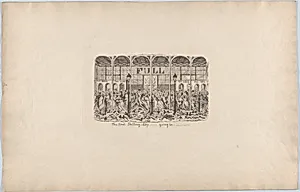
The First Shilling Day–Going In
Medium
Etching
Dimensions
Plate: 5 1/2 × 8 11/16 in. (14 × 22 cm) Sheet: 12 1/2 × 19 11/16 in. (31.8 × 50 cm)
Classification
Prints
Department
Drawings and Prints
Museum
Metropolitan Museum of Art, New York, NY
Credit
The Elisha Whittelsey Collection, The Elisha Whittelsey Fund, 1966
Accession Number
66.541.55(7)
Rights
Public Domain
Tags
Art Historical Context
George Cruikshank’s 1851 etching *The First Shilling Day–Going In* captures a lively moment from the Great Exhibition at London’s Crystal Palace. Published by David Bogue, the print shows a bustling crowd pressing forward on the first affordable “shilling day,” when admission dropped from five shillings to one. This pricing innovation, championed by Prince Albert, allowed working-class visitors to experience the wonders of industry and empire that had previously been reserved for wealthier audiences. Cruikshank, celebrated for his sharp social satire, uses lively line work and exaggerated figures to convey both excitement and gentle humor. The etching technique, with its fine, expressive lines, was ideally suited to mass-produced prints that circulated widely in Victorian Britain, turning topical events into shared visual commentary. Acquired by the Metropolitan Museum through the Elisha Whittelsey Fund, the work preserves a vivid record of how the Great Exhibition briefly bridged class divides while showcasing the era’s fascination with progress and spectacle.
About the Artist
George Cruikshank|David Bogue · 1792–1878
George Cruikshank (1792–1878) was born in London on 27 September 1792, the son of Scottish caricaturist Isaac Cruikshank and Mary MacNaughton. His older brother, Isaac Robert Cruikshank, was also a caricaturist and illustrator, while his sister Eliza worked as a designer. From a young age, Cruikshank assisted his father in the studio, contributing titles, backgrounds, and lettering to cartoons by ...