
The Fisher
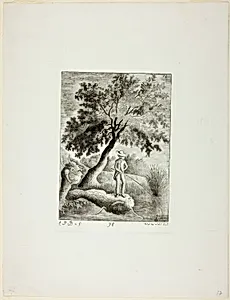
Medium
Etching, with roulette and drypoint, on white wove paper
Dimensions
Image: 16 × 11.9 cm (6 5/16 × 4 11/16 in.); Plate: 17.8 × 12.8 cm (7 1/16 × 5 1/16 in.); Sheet: 31.8 × 24.4 cm (12 9/16 × 9 5/8 in.)
Classification
etching
Department
Prints and Drawings
Museum
Art Institute of Chicago
Accession Number
74130
Rights
Public Domain
Art Historical Context
**The Fisher** (1863) by French artist Emmanuel Phelippes-Beaulieu captures a quiet moment of everyday life through masterful printmaking. Created during the mid-19th century—a time when Realism was gaining prominence in European art—this etching depicts a solitary fisherman, evoking the humble labors of rural or coastal existence. Housed in the Art Institute of Chicago's Prints and Drawings Department, the work measures a modest image size of 16 × 11.9 cm, inviting intimate contemplation on its white wove paper sheet. Phelippes-Beaulieu employs a sophisticated blend of etching, roulette, and drypoint techniques, showcasing the era's innovative approaches to intaglio printing. Etching uses acid to etch precise lines into a metal plate, while drypoint's direct needle scratches create velvety burrs for rich tonal depth. The roulette—a spiked wheel—adds textured shading, enhancing the scene's atmospheric subtlety and three-dimensionality. These methods highlight the printmaker's skill in achieving painterly effects on paper, a hallmark of 19th-century graphic arts revival. As a fine example of technical experimentation, **The Fisher** reflects the period's fascination with capturing light, texture, and human stories through accessible prints, bridging fine art and reproduction. Visitors will appreciate its delicate craftsmanship, a testament to printmaking's enduring allure.