
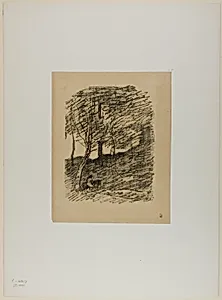
Beneath the Trees
Medium
Transfer lithograph printed in black on tan China paper laid down on white wove paper, retouched by hand
Dimensions
Image: 22 × 16.5 cm (8 11/16 × 6 1/2 in.); Chine: 28.1 × 22 cm (11 1/8 × 8 11/16 in.); Sheet: 54.3 × 40 cm (21 7/16 × 15 3/4 in.)
Classification
lithograph
Department
Prints and Drawings
Museum
Art Institute of Chicago
Accession Number
84413
Rights
Public Domain
Art Historical Context
Jean-Baptiste-Camilleot's *Beneath Trees* (1871) captures the artist's lifelong passion for the tranquil beauty of nature, a hallmark of his Barbizon School style. As a pioneer of plein-air painting, Cor blended classical structure with soft, atmospheric light, influencing Impressionists like Monet. Created late in his career—just four years before his death—this print evokes a peaceful woodland scene, likely inspired by the forests of Fontainebleau or Italy, where Corot sketched extensively. This work is a transfer lithograph, a technique where Corot's original drawing was transferred to a lithographic stone for printing in black ink on delicate tan China paper, then laid down on sturdy white wove paper and hand-retouched for added depth. At 22 × 16.5 cm, its intimate scale invites close viewing, showcasing lithography's ability to mimic drawing's fluidity while allowing multiples. Housed in the Art Institute of Chicago's Prints and Drawings department, it highlights Corot's innovative bridge between painting and printmaking. Though modest in size, *Beneath the Trees* reflects 19th-century Romanticism's reverence for nature's quiet poetry, offering visitors a tactile glimpse into Corot's masterful touch.