
The Fisherman's Family
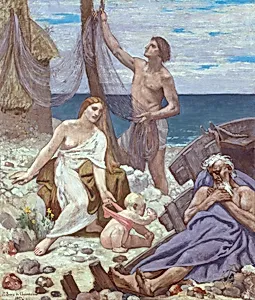
Medium
Oil on canvas
Dimensions
82.5 × 71.8 cm (32 1/2 × 28 1/4 in.); Framed: 102.9 × 91.4 × 10.2 cm (40 1/2 × 36 × 4 in.)
Classification
oil on canvas
Department
Painting and Sculpture of Europe
Museum
Art Institute of Chicago
Accession Number
71191
Rights
Public Domain
Art Historical Context
Pierre Puvis de Chav's *The Fisherman's Family*1887) captures a serene moment of everyday life along the French coast, painted in oil on canvas at a modest 82.5 × 71.8 cm. As a leading figure in late 19th-century French Symbolism, Puvis depicted humble subjects—peasants, fishermen, and villagers—in timeless, dreamlike scenes that evoke harmony with nature. This work reflects his fascination with Brittany's rugged shores, where he frequently painted, blending realism with poetic idealism amid the era's social upheavals like industrialization. Puvis's technique stands out for its mural-like quality: simplified forms, soft contours, and matte colors applied thinly to mimic frescoes, creating a flattened, almost timeless space. Unlike the dramatic light of Impressionism, his subdued palette and gentle modeling emphasize emotional quietude over optical effects, influencing artists like Gauguin and the Nabis. Oil on canvas allowed this intimacy, contrasting his grand public murals for Paris landmarks. Housed in the Art Institute of Chicago's Department of European Painting and Sculpture, *The Fisherman's Family* invites visitors to ponder the dignity of labor and the enduring beauty of simplicity, a poignant reminder of Symbolism's quest for spiritual depth in the modern world.
About the Artist
Pierre Puvis de Chavannes · 1824–1898
Pierre Puvis de Chavannes (1824–1898) was a French painter who became the foremost muralist of nineteenth-century France and a crucial bridge between academic tradition and modernism. Born in Lyon to a prosperous family, he studied briefly with Henri Scheffer and Thomas Couture in Paris and traveled to Italy, where the frescoes of the Italian Renaissance made a lasting impression on his artistic v...