
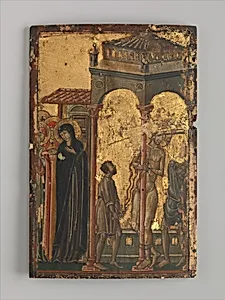
The Flagellation
first half 14th century
Medium
Tempera on wood, gold ground
Dimensions
Overall: 7 3/4 x 5 1/4 in. (19.7 x 13.3 cm); Painted Surface (excluding painted borders): 7 3/8 x 4 5/8 in. (18.7 x 11.7 cm)
Classification
Paintings
Culture
Italian, Romagna
Department
Robert Lehman Collection
Museum
Metropolitan Museum of Art, New York, NY
Credit
Robert Lehman Collection, 1975
Accession Number
1975.1.79
Rights
Public Domain
Tags
Art Historical Context
In the quiet intimacy of a small devotional panel, *The Flagellation* by the Master of Forlì captures a pivotal moment from Christ's Passion: the scourging of Jesus before his crucifixion. Created in the first half of the 14th century in Romagna, Italy, this tempera on wood with gold ground measures just 7 3/4 x 5 1/4 inches, suggesting it was designed for private prayer, perhaps as part of a portable altarpiece or diptych owned by a wealthy devotee. The Master's anonymous style reflects the Italian Gothic tradition, blending linear elegance with emotional intensity. Figures of Christ, tormentors, and onlookers—men and women—unfold against a shimmering gold ground, a technique symbolizing divine light and the heavenly realm. Tempera, made from pigments bound with egg yolk, allowed for vibrant colors and fine details on the wooden panel, a hallmark of pre-Renaissance Italian painting in regions like Romagna, influenced by Byzantine mosaics from nearby Ravenna. Housed in the Metropolitan Museum of Art's Robert Lehman Collection since 1975, this work exemplifies the era's focus on religious narrative and piety, inviting viewers to meditate on suffering and redemption. Its compact scale and radiant gold evoke the spiritual fervor of medieval Italy, bridging everyday devotion with sacred drama.