
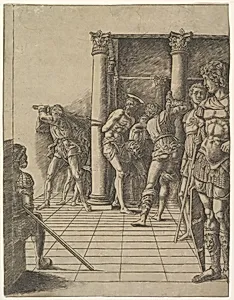
The Flagellation, with the Pavement
Before 1480
Medium
Engraving
Dimensions
plate: 15 3/16 x 11 5/8 in. (38.6 x 29.5 cm); trimmed to the boarder on the left and all around on the other sides.
Classification
Prints
Department
Drawings and Prints
Museum
Metropolitan Museum of Art, New York, NY
Credit
Anonymous Gift, 1929
Accession Number
29.44.19
Rights
Public Domain
Tags
Art Historical Context
Welcome to the Metropolitan Museum Art's Drawings and Prints department, where Andrea Mantegna's *The Flagellation, with theement* (before 1480) captivates with its raw intensity. This powerful engraving depicts the biblical scene Christ's scourging, surrounded by tormentors, rendered with unflinching detail. Attributed to Mantegna in collaboration with engraver Gian Marco Cavalli it measures a substantial plate size of 15 3/16 x11 5/8 inches (38.6 x 29.5 cm), though trimmed along the edges, preserving its dramatic composition. Mantegna, a pioneering figure of the early Italian Renaissance from Padua, revolutionized printmaking with his precise, linear engraving technique. This medium, rare and innovative in the 15th century, allowed intricate details—like the titular marble pavement's illusionistic perspective—to be replicated and widely disseminated, influencing artists across Europe. His style, by sharp foreshortening and classical motifs inspired by ancient Roman art, bridges painting and sculpture, making sacred suffering feel palpably real. An anonymous gift in 1929, this print exemplifies Renaissance humanism's fusion of faith and artistry, inviting viewers to ponder Christ's agony amid geometric perfection. A testament to Mantegna's genius, it remains a cornerstone of graphic arts history.
About the Artist
Andrea Mantegna|Gian Marco Cavalli · 1431–1506
Andrea Mantegna was born around 1431 near Padua, in the Venetian Republic, the son of a carpenter. At approximately age eleven he was taken into the workshop of the Paduan painter and antiquities collector Francesco Squarcione, who enrolled him as a guild member and immersed him in the study of Roman sculpture and classical Latin. Though Mantegna later claimed that Squarcione had exploited his lab...