
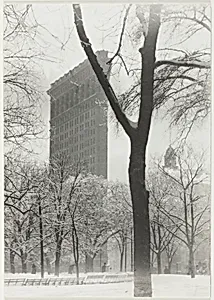
The Flatiron
1903, printed 1920/39
Medium
Gelatin silver print
Dimensions
Image/paper/first mount: 12 × 8.4 cm (4 3/4 × 3 5/16 in.); Second mount: 32 × 24.8 cm (12 5/8 × 9 13/16 in.)
Classification
gelatin silver (developing-out-paper) pr
Department
Photography and Media
Museum
Art Institute of Chicago
Accession Number
66315
Rights
Public Domain
About this artwork
In an article in 1946, Stieglitz recalled photographing the newly erected Flatiron Building on the day of a great snowstorm. “I suddenly saw the Flat-Iron Building as I had never seen it before. It looked, from where I stood, as if it were moving toward me like the bow of a monster ocean steamer, a picture of the new America which was in the making.” For more on the Alfred Stieglitz collection at the Art Institute, along with in-depth object information, please visit the website: The Alfred Sti...
Art Historical Context
Alfred Stieglitz's *The Flatiron*, captured in 1903 and printed later between 1920 and 1939, stands as a landmark in early 20th-century photography. This gelatin silver print immortalizes New York's iconic Flatiron Building—named for its wedge-like shape—at a moment when skyscrapers were redefining the urban skyline. Stiegl, a pioneering advocate for photography as fine art, photographed the structure amid swirling mist and twilight, ev a sense of mystery and amid the city's rapid transformation. Printed on gelatin silver developing-out paper, the image exemplifies the technical advancements of the era, allowing for rich tonal depth and subtle gradations that blurred the line between photography and painting. Stieglitz's Pictorialist approach softened edges to mimic impressionistic effects, yet this work foreshadowed his shift toward "straight photography," emphasizing the medium's unique realism. Housed in the Art Institute of Chicago's Photography and Media department, it measures a intimate 12 × 8.4 cm on its original mount, inviting close contemplation. As a cornerstone of Photo-Secession—the movement Stieglitz championed—the photograph not only documented architectural innovation but elevated urban scenes to poetic heights, influencing generations of photographers to capture the poetry of the everyday.
About the Artist
Alfred Stieglitz · 1864–1946
Alfred Stieglitz (1864-1946) was a pioneering American photographer, art dealer, publisher, and advocate for the Modernist movement who was instrumental over his 50-year career in making photography an accepted art form. Born in Hoboken, New Jersey, to German Jewish immigrant parents, Stieglitz spent his formative years studying mechanical engineering in Berlin, where he discovered photography in ...