
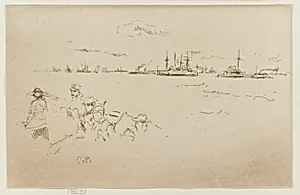
The Fleet: Monitors
Classification
Department
Smithsonian Collection
Museum
Smithsonian American Art Museum
Credit
Gift of Charles Lang Freer
Accession Number
F1888.4
Rights
Public Domain
Tags
About this artwork
Whistler etchings are identified by "G" numbers as assigned in "James McNeill Whistler: The Etchings, a catalogue raisonne," by Margaret F. McDonald, Grischka Petri, Meg Hausberg, and Joanna Meacock (University of Glasgow, 2012), http://etchings.arts.gla.ac.uk. This print is G306 state 1 of 2.
Art Historical Context
James McNeill Whistler’s 1887 etching *The Fleet: Monitors* captures a quiet study of naval vessels through the artist’s signature economy of line. An American expatriate working in Britain, Whistler had by this date established himself as one of era’s most innovative printmakers. The sheet belongs to his later series of Thames and coastal subjects, rendered with the delicate, atmospheric touch that earned his etchings the affectionate nickname “Rembrandt’s little children.” Identified as state 1 of 2 (G306) in the modern catalogue raisonné, the print reveals Whistler’s meticulous working method. He used fine, controlled lines and selective wiping of the plate to suggest both the solid forms of the ironclad monitors and the reflective surface of the water. The result is less a documentary record than a tonal harmony of light and structure, consistent with the Aesthetic Movement’s emphasis on beauty over narrative. This impression entered the Smithsonian American Art Museum as part of Charles Lang Freer’s celebrated gift. Freer’s close friendship with Whistler ensured that many of the artist’s most subtle proofs remain together, allowing visitors today to appreciate the quiet power of Whistler’s graphic work.