
The Flemish Farrier
Medium
Lithograph
Dimensions
sheet: 16 9/16 x 22 13/16 in. (42.1 x 57.9 cm) plate: 9 9/16 x 12 11/16 in. (24.3 x 32.2 cm)
Classification
Prints
Department
Drawings and Prints
Museum
Metropolitan Museum of Art, New York, NY
Credit
Rogers Fund, 1920
Accession Number
20.17.9
Rights
Public Domain
Tags
Art Historical Context
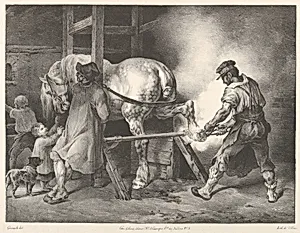
**The Flemish Farrier**1822) by Thé Géricault invites visitors into a bustling scene of 19th-century working life at the Metropolitan Museum of Art's Drawings and Prints department. lithograph captures a Flemish blacksmith—or farrier—at his forge, surrounded by sturdy men, curious children, loyal dogs, and powerful horses. Géricault, a leading French Romantic artist known for dramatic compositions like *The Raft of the Med*, here turns his keen eye to everyday labor, infusing the ordinary with vitality and raw energy. Lithography, a revolutionary printing technique Géricault helped pioneer, allowed him to draw directly on stone for intricate details and painterly tones—far surpassing earlier prints. The modest plate size (9 9/16 x 12 11/16 in.) draws viewers close to the textures of sweat-glistened skin, taut muscles, and restless animals, making high art feel immediate and accessible in an era of industrial change. Acquired via the Rogers Fund in 1920, this work reflects Romanticism's fascination with human strength and nature's nobility amid Europe's social shifts. A window into Géricault's brief career (he died at 32), it celebrates the unsung heroes of the forge, blending technical innovation with heartfelt observation.
About the Artist
Théodore Gericault · 1791–1824
Théodore Géricault, born Jean-Louis André Théodore Géricault on September 26, 1791, in Rouen, France, into a prosperous family—his father a lawyer turned tobacco merchant and his mother from a line of growers—moved to Paris around 1797. Displaying early artistic promise, recognized by painter Jean-Louis Laneuville, he began formal training in 1808 under Carle Vernet, mastering English sporting art...