
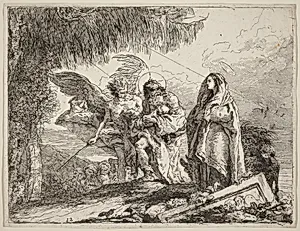
The Flight, Holy Family Walking with Angel
published 1753
Medium
etching
Classification
Department
CG-E
Museum
National Gallery of Art, Washington, D.C.
Credit
Rosenwald Collection
Accession Number
1943.3.8104
Rights
Public Domain
Art Historical Context
Behold the graceful etching *The Flight, Holy Family with Angel* by Giovanni Domenico Tiep, published in 1753. This poignant print captures a classic biblical scene from the New Testament: the Holy FamilyMary, Joseph, and the infant Jesus—fleeing to Egypt under the guidance of a protective angel, evading King Herod's massacre of the innocents. As the son of the illustrious Venetian master Giovanni Battista Tiepolo Domenico carried forward the family's Rococo legacy, blending dramatic movement, soft lighting, and ethereal elegance in his works. Etching, Tiepolo's chosen medium here, allowed for intricate line work etched into a metal plate with acid, enabling the reproduction of his fluid drawings for wider audiences. This technique highlights his mastery of Rococo's playful yet devotional style, with swirling drapery and dynamic poses that infuse the sacred narrative with emotional warmth and narrative grace. Produced during Venice's vibrant 18th-century printmaking boom, it reflects the era's fascination with religious iconography accessible to collectors and devotees alike. Housed in the National Gallery of Art's Rosenwald Collection (Department CG-E), this print exemplifies Tiepolo's skill in transforming grand frescoes into intimate, portable art. A testament to artistic innovation, it invites visitors to ponder themes of protection and exile that resonate across centuries.
About the Artist
Giovanni Domenico Tiepolo · 1727–1804
Giovanni Domenico Tiepolo (1727-1804) was a Venetian painter, printmaker, and draftsman whose career spanned the twilight of the Rococo era. Born on August 30, 1727, in Venice as the eldest son of the celebrated Giovanni Battista Tiepolo, he worked both in his father's shadow and as a significant independent artist who developed a distinctly earthbound and humanistic vision. Domenico's importance...