
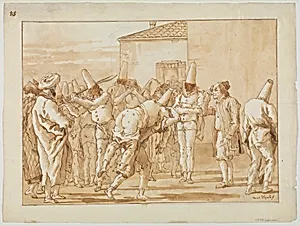
The Flogging of Punchinello
ca. 1800
Medium
Pen and brown ink, brown wash, over black chalk
Dimensions
14 x 19 1/8 in. (35.6 x 48.5 cm)
Classification
Drawings
Department
Robert Lehman Collection
Museum
Metropolitan Museum of Art, New York, NY
Credit
Robert Lehman Collection, 1975
Accession Number
1975.1.467
Rights
Public Domain
Tags
Art Historical Context
Giovanni Domenico Tiepolo’s *The Flogging of Punchinello* captures a lively, theatrical moment from the misadventures of the commedia dell’arte character Punchinello. Created around 1800, the drawing reflects Tiepolo’s late-career interest in narrative scenes that blend humor, satire, and everyday Venetian life. As the son of the celebrated Giambattista Tiepolo, Domenico carried forward a distinctive Rococo sensibility while exploring more intimate, anecdotal subjects in his drawings. Executed in pen and brown ink with delicate brown wash over black chalk, the work showcases Tiepolo’s fluid draftsmanship and masterful control of light and shadow. This technique allowed him to suggest both the physical energy of the scene and the expressive gestures of the figures with economical yet vivid strokes. The medium’s transparency and tonal range give the composition a sense of immediacy, as if the viewer has stumbled upon a street performance. Now part of the Metropolitan Museum’s Robert Lehman Collection, the drawing offers a window into early nineteenth-century European fascination with popular theater and caricature. Its modest scale and spontaneous handling invite close looking, rewarding visitors with the charm and wit that defined Tiepolo’s vision of human folly.
About the Artist
Giovanni Domenico Tiepolo · 1727–1804
Giovanni Domenico Tiepolo (1727-1804) was a Venetian painter, printmaker, and draftsman whose career spanned the twilight of the Rococo era. Born on August 30, 1727, in Venice as the eldest son of the celebrated Giovanni Battista Tiepolo, he worked both in his father's shadow and as a significant independent artist who developed a distinctly earthbound and humanistic vision. Domenico's importance...